
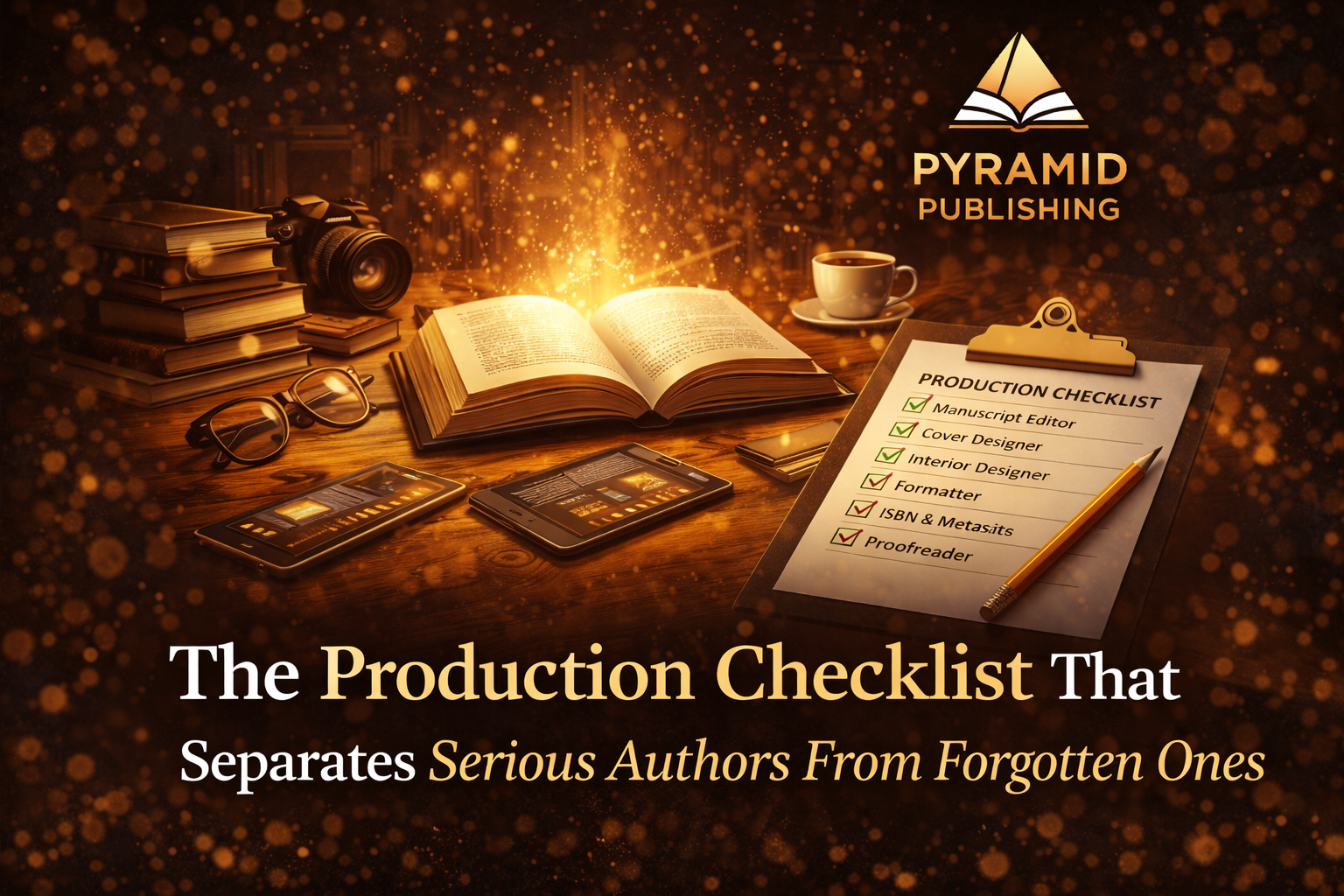
The difference between a book that finds its readers and builds a career, and a book that languishes in obscurity despite containing genuinely valuable content, is rarely the quality of the ideas inside it. It is almost always the quality of every decision made outside of the writing, the production decisions, the distribution decisions, the marketing decisions. This checklist is a comprehensive review of every production element that separates professionally published books from amateur ones. It is the standard that every book published through Pyramid Publishing meets, and it is the standard that every serious author should insist upon regardless of their publishing route. Work through this checklist against your book, whether it is in preparation, recently published, or under consideration. Every item that is not checked is an opportunity to improve your book’s commercial performance and professional credibility, and Pyramid Publishing‘s professional publishing service addresses every item on this list for every book we produce. Editorial Checklist ☐ Developmental editing completed, The book’s structure, argument, pacing, and content have been reviewed by a professional editor and refined to the highest standard before copy editing begins. ☐ Copy editing completed, Every sentence has been reviewed for grammar, punctuation, style consistency, and clarity. No grammatical errors, style inconsistencies, or unclear passages remain. ☐ Proofreading completed, A final, dedicated proofread has been conducted on the formatted text, catching any errors introduced during the typesetting process. ☐ Fact-checking conducted, All factual claims, statistics, quotations, and attributions have been verified for accuracy. ☐ Permissions secured, All third-party content used in the book, quotations, images, data, has been properly licensed or falls within fair use provisions. Cover Design Checklist ☐ Category-appropriate design, The cover’s visual language correctly signals the book’s genre to its target reader. ☐ Title legible at thumbnail scale, The title and author name are readable at the one-inch thumbnail size used in Amazon search results. ☐ Professionally designed, The cover was produced by a specialist book cover designer with publishing market knowledge, not a generalist graphic designer or template tool. ☐ Back cover copy professionally written, The back cover text is persuasive, compelling marketing copy, not a summary. ☐ Correct technical specifications, The cover file meets the exact technical specifications, resolution, colour profile, bleed, trim size, of every platform it will be used on. ☐ Spine design correct, The spine is correctly sized for the book’s page count and contains the title, author name, and publisher information in the correct format. Interior Design and Formatting Checklist ☐ Professional typesetting, The interior was typeset using professional typesetting software to publishing industry standards. ☐ Genre-appropriate typography, The typeface, point size, and leading are appropriate for the book’s genre and optimised for reading comfort. ☐ Widows and orphans corrected, No isolated single lines appear at the top or bottom of any page. ☐ Chapter openings professionally designed, Each chapter opening is visually distinct and consistently executed throughout the book. ☐ Running headers and footers consistent, Running headers or footers appear consistently throughout the book in the correct format. ☐ Correct page count, The final page count is within the specified range for the chosen trim size, ensuring correct spine width calculation. ☐ Print-ready PDF produced, The final interior PDF meets the exact technical requirements of the print production platform. ☐ EPUB file produced and validated, A correctly formatted, validated EPUB file has been produced and tested on all major ebook platforms. “The checklist is not bureaucracy. Every item represents a publishing decision that affects how your book performs in the market.” ISBN and Metadata Checklist ☐ Independent ISBN registered, An independently registered ISBN is assigned to each edition of the book, with the correct publisher of record. ☐ BISAC codes correctly selected, The book is assigned the correct BISAC category codes for its content and target audience. ☐ Retail description optimised, The long and short descriptions on retail platforms are keyword-rich, compelling, and correctly formatted. ☐ Pricing correctly set, Retail prices are set appropriately for the book’s category and market, with correct discount terms for wholesale distribution. ☐ Contributor information complete, Author name, biography, and photo are correctly entered across all distribution platforms. ☐ Publication date confirmed, A specific publication date has been registered across all platforms and in all bibliographic databases. Distribution Checklist ☐ Amazon KDP configured, Print and ebook editions are listed and correctly configured on Amazon UK and Amazon US, with appropriate pricing for each marketplace. ☐ IngramSpark distribution active, The book is listed in the IngramSpark wholesale catalogue, available for ordering by any bookshop or library worldwide. ☐ Digital distribution configured, Ebook distribution is live on Apple Books, Kobo, Google Play Books, Barnes & Noble, and all other major digital platforms. ☐ Library distribution active, The book is available through Baker & Taylor and Ingram for library acquisition. ☐ International territories confirmed, Distribution rights and pricing have been set correctly for all intended international markets. Launch and Marketing Checklist ☐ Professional best-seller marketing campaign planned, A coordinated, multi-channel marketing campaign has been developed and scheduled for launch. ☐ Amazon advertising campaign configured, Sponsored Products campaigns are set up and ready to activate on publication day. ☐ Review generation campaign active, ARC distribution and early reader outreach has been conducted to ensure review accumulation from day one. ☐ Media outreach scheduled, Pitches to relevant journalists, podcast hosts, and bloggers are prepared and timed for launch week. ☐ Social media content scheduled, Launch week social media content is prepared and scheduled across all relevant author platforms. ☐ Email marketing campaign ready, Launch announcement email campaign is prepared for any existing reader or subscriber list. Your Next Step How many items on this checklist can you check right now for your book? Every unchecked item is a gap between where your book is and where it could be. Every gap is a publishing or marketing decision that has not yet been made correctly, and that is costing your book commercial performance every day it remains unchecked. Pyramid Publishing‘s full-service professional publishing package addresses

5 Reasons Your Book Deserves Better Than a Cheap Publishing Platform
The internet is full of cheap publishing platforms. Upload your manuscript, click publish, your book is available on Amazon in 48 hours. Free or very close to it. Easy. Fast. No expertise required. And the result is precisely what you would expect from a service designed to make publishing free and fast: a book that looks like it cost nothing to produce, reads like it was formatted by a computer, and performs in the market like a title that nobody has invested in, because nobody has. Your book is not a product that should be produced cheaply, quickly, and with no professional expertise applied to its creation. Your book is the written record of expertise you have spent years developing, stories you have lived, and ideas that have the potential to change how your readers think, work, or live. It deserves better. Here are five specific reasons why professional publishing services from Pyramid Publishing will produce outcomes that cheap publishing platforms are structurally incapable of delivering. Reason One: Cheap Platforms Produce Amateur Products The most fundamental problem with cheap publishing platforms is the quality of the output. Books produced through automated publishing tools have consistently identifiable characteristics: covers that look like they were built from templates, interiors typeset with default settings that produce awkward line breaks and inconsistent spacing, and print quality that falls below the standard of any professionally produced title in the same category. These are not minor cosmetic issues. They are commercial handicaps that affect every aspect of the book’s performance in the market. A reader who encounters a book with an amateur cover at thumbnail scale on Amazon does not click. A reader who picks up a book with rough interior formatting puts it down. A book reviewer who receives an amateur-looking book puts it at the bottom of their pile. Every reader, every reviewer, and every media professional who encounters your book makes a quality assessment within seconds. Cheap platforms consistently fail that assessment. Pyramid Publishing‘s professional publishing service produces a book that passes every quality assessment, a book that looks, feels, and reads like a title from a major publishing house, because it is produced to the same professional standards. Reason Two: Cheap Platforms Limit Your Distribution The most widely used cheap publishing platforms are essentially single-retailer distribution services. They make your book available through their own ecosystem and connected channels, but they do not provide the wholesale distribution infrastructure that gets your book into bookshop ordering catalogues and library supply systems. This distribution limitation is commercially significant. It means your book is not available to the bookshop buyer who might stock it. It means the library acquisition manager who searches for titles on your subject will not find yours. It means the institutional purchaser looking for books on your topic through their standard supply channels will not encounter your title. Pyramid Publishing‘s professional publishing and global distribution service puts your book into every channel that matters, retail, wholesale, library, and digital, from the moment it launches. Reason Three: Cheap Platforms Own Your ISBN Most free and low-cost publishing platforms assign your book an ISBN from their own registry, making the platform the publisher of record rather than you. This has practical and commercial consequences. When a bookshop buyer, a library acquisition manager, or a corporate purchaser looks up your book in bibliographic databases, they see the cheap platform’s name as the publisher. For buyers who apply quality filters based on publisher reputation, this is a disqualifying signal. For authors who want to represent their book as a professional, independently published title, it is a misrepresentation of the book’s status. Pyramid Publishing registers independent ISBNs for every book in our publishing service, with your name or your personal imprint as the publisher of record. Your book is presented to the world as what it is: a professionally published independent title. Reason Four: Cheap Platforms Provide No Expert Guidance Cheap platforms are tools, not teams. They process your files and your metadata and return a published listing. They do not tell you that your cover is wrong for your category, that your pricing is set too high for your target market, that your BISAC codes are directing your book to the wrong readers, or that your description is failing to convert browsers into buyers. Publishing a book correctly requires dozens of decisions, pricing strategy, category selection, metadata optimisation, cover design, interior layout choices, distribution channel selection, launch timing, that have significant commercial consequences and that most authors are not equipped to make without professional guidance. Pyramid Publishing‘s professional publishing service provides expert guidance at every decision point, not just the technical process of getting your files onto a platform, but the strategic intelligence that makes every publishing decision commercially sound. Reason Five: Cheap Platforms Have No Investment in Your Success A cheap or free publishing platform’s business model does not require your book to succeed. Their revenue comes from volume, from the thousands of authors who upload books, not from the commercial performance of any individual title. There is no financial incentive for a cheap platform to ensure that your book is competitive, discoverable, or well-positioned in its market. Pyramid Publishing‘s business model is different. Our reputation and our growth depend on the quality of the books we publish and the success of the authors we work with. Your book’s success is our success. That alignment of incentives produces a level of care, attention, and professional investment in every detail of your book’s production that a cheap platform is structurally incapable of providing. “A cheap platform processes your book. A professional publishing service invests in it. The difference shows in every copy sold.” What the Right Investment Looks Like Professional publishing from Pyramid Publishing is a bounded, specific, one-time investment that produces a book positioned to perform commercially over years and decades. The return on that investment, in royalties, in professional opportunities, in the career impact of a book that looks and performs at

From Manuscript to Global Distribution: What Professional Publishing Actually Covers!
Most authors think of publishing as a single step, the moment a book becomes available for sale. It is not a single step. It is a sequence of interdependent professional processes that begins with a finished manuscript and ends with a book that is discoverable, purchasable, and accessible to readers in every country where your audience exists. Understanding what this sequence actually involves, and understanding why each step requires professional expertise, is the prerequisite for making intelligent decisions about how to publish your book. It is also the reason that a single, coordinated professional publishing service is so much more effective than attempting to manage each step independently. At Pyramid Publishing, our full-service professional publishing package covers every step in this sequence, from the moment your manuscript is delivered to us to the moment your book is live across global retail and library channels. Here is exactly what that covers. Stage One: Editorial Assessment and Manuscript Preparation Before design or production begins, your manuscript requires professional editorial assessment. Our editorial team reviews your manuscript for structural integrity, voice consistency, factual accuracy, and readiness for publication. If significant structural work is required, this is identified and addressed at this stage, preventing costly revisions later in the production process. Following the assessment, the manuscript passes through copy editing, a detailed review of grammar, punctuation, style consistency, and clarity, and then proofreading, which catches every remaining error before the text is locked for typesetting. No word of your book enters the design phase before it has been professionally reviewed and approved for production. Stage Two: Interior Book Design and Typesetting With a clean, professionally edited manuscript, our interior design team begins the typesetting process. This involves selecting the appropriate typeface and typographic system for your genre, setting correct margins and line spacing, establishing chapter architecture, creating all necessary front and back matter pages, and producing a final interior layout file in the correct technical format for both print and digital production. The typesetting stage is where your manuscript becomes a book. The decisions made here, about how the text appears on the page, how chapters open, how sections are delineated, how images and tables are positioned if applicable, determine the reading experience your book delivers. Professional typesetting honours the reader by making the text as easy and pleasurable to read as possible. The final typeset file is delivered in PDF format for print production and in a reflowable format for ebook conversion, both tested against the technical requirements of every platform the book will be distributed through. Stage Three: Cover Design Parallel to the interior typesetting, our cover design team develops the cover. As detailed elsewhere in this series, cover design is a specialist discipline that requires deep knowledge of category conventions, reader psychology, and the specific technical requirements of print and digital publishing. Our cover design process produces a full-size print cover with spine and back, a standalone ebook cover, and all format variations required for retail distribution. Stage Four: ISBN Registration and Metadata Preparation Before your book can be distributed, it requires an ISBN, a unique identifier that catalogues your book in the global bibliographic databases used by retailers, libraries, and distributors worldwide. Pyramid Publishing registers your ISBN independently, ensuring the publisher of record reflects your professional status rather than a self-publishing platform’s imprint. Alongside ISBN registration, we prepare the complete metadata package required for effective distribution: BISAC category codes, territorial rights specifications, publishing date, pricing structure for each territory, short and long descriptions optimised for retail discovery, contributor information, and all technical specifications required by the distribution platforms your book will appear on. Metadata is the invisible infrastructure of book discoverability. Books with incomplete, incorrect, or unoptimised metadata are systematically disadvantaged in retail search and catalogue systems. Getting it right requires knowledge of the specific requirements of each distribution platform and the experience to apply that knowledge correctly. Stage Five: Print Production Setup Print production begins with the submission of your print-ready PDF to our print production partner. Pyramid Publishing works with IngramSpark for print-on-demand production, the industry standard for professional self-published books. The setup process involves selecting the correct trim size, paper type, binding style, and cover finish for your book, and submitting all files in the exact technical specification that IngramSpark requires. A proof copy is printed and reviewed by our production team, checking that the print quality matches the design files, that the cover aligns correctly with the spine and back, that the paper and binding meet the standards we require for all our titles, and that the finished object represents the professional publication your book deserves to be. Only after the proof is approved does your book go live for print orders. This quality gate prevents the substandard print outcomes that affect books published without professional production oversight. Stage Six: Ebook Conversion and Digital Distribution Your book requires conversion to ebook format, specifically EPUB3, the current standard format used by all major ebook platforms, before it can be listed on digital retail channels. Pyramid Publishing‘s professional ebook conversion service produces a correctly formatted, validated EPUB file that displays correctly across Kindle, Apple Books, Kobo, Google Play Books, and all other major ebook platforms. Ebook formatting is more technically demanding than most authors expect. Reflowable text, correct heading hierarchy, functional table of contents, properly linked footnotes, correctly formatted images, all of these elements require technical precision that generic file conversion tools frequently fail to achieve. Our ebook files pass validation testing on every platform before distribution begins. Stage Seven: Global Retail and Library Distribution With all files prepared and approved, distribution begins. Pyramid Publishing‘s global distribution service places your book across: Distribution is live within 24 to 72 hours on most digital platforms and within two to four weeks on physical retail channels and library catalogues. Your book is available globally from day one. Stage Eight: Launch and Marketing Transition The publishing process does not end with distribution. It ends with a successful book launch campaign

Why Your Book Cover Is a Business Decision, Not a Design Preference!
Authors who treat their book cover as a personal preference, a question of which colour they prefer, which image they find most evocative, which design they feel best captures the book’s spirit, are making a category error with significant commercial consequences. A book cover is not a self-expression exercise. It is a marketing tool. Its function is not to satisfy the author’s aesthetic preferences. Its function is to convert a browsing reader into a buying one, at a range of contexts, sizes, and durations of attention that give it approximately one-third of a second per encounter to do its job. Every design decision on your book cover, the typeface, the colour palette, the imagery, the hierarchy, the finish, should be made in service of that commercial function. And making those decisions correctly requires expertise that most authors and most generic designers simply do not have. It requires a professional book cover design service from specialists who understand the publishing market, like the team at Pyramid Publishing. The Cover’s Job Description Category Identification in Under a Second The first job of a book cover is to tell a reader, in under a second, what kind of book this is. Category identification happens at the level of colour palette, compositional style, typeface choice, and imagery type, all of which carry genre signals that experienced readers have internalised from decades of book exposure. A business book that looks like a thriller cover will confuse its target reader and prevent the recognition response that triggers engagement. A memoir that uses the graphic design conventions of a self-help book will send the wrong signal about what kind of reading experience to expect. Getting category identification right is the prerequisite for every other commercial function the cover performs. Author and Title Legibility at Thumbnail Scale The majority of book discoveries in the contemporary market happen at thumbnail scale, in Amazon search results, in social media recommendations, in email newsletters, in online review features. At this scale, covers with complex imagery, text-heavy designs, or low-contrast colour combinations become indecipherable. Pyramid Publishing‘s professional cover designers test every design at thumbnail scale before finalising it, ensuring that your title and author name are legible at every size at which the cover will appear. This is a standard that many amateur and generalist designers do not even know to apply. Compelling Differentiation In the context of an Amazon category page, your cover competes visually with dozens of other covers simultaneously. A cover that looks generic, that uses the same stock image as three other books in the same category, or that deploys the same design conventions so closely as to be interchangeable with competing titles, is a cover that does not differentiate. A cover that is distinctive, that uses category conventions as a foundation while adding a specific visual element that makes it immediately recognisable as its own thing, is a cover that earns the click that the generic one loses. Finding this balance between category recognition and distinctive identity is one of the highest skills of professional book cover design. “The best book cover is the one that makes the right reader stop scrolling. That is a functional requirement, not an aesthetic one.” The Business Case for Professional Cover Design Click-Through Rate In online retail, click-through rate, the percentage of readers who, having seen your book in a search result or a recommendation, click through to the full listing page, is directly determined by the cover’s visual performance. A professionally designed cover consistently generates higher click-through rates than amateur alternatives. Higher click-through means more readers reaching your listing. More readers reaching your listing means more potential sales. Conversion Rate Once a reader reaches your listing page, the cover is the largest and most immediately visible element. Its quality either supports or undermines everything else on the page, the description, the reviews, the author bio. A professional cover creates a positive first impression that makes the reader more receptive to everything else. An amateur cover creates doubt that the description and reviews must work to overcome. Review and Media Credibility Book reviewers, podcast hosts, and media professionals make rapid quality assessments based partly on cover design. A book that arrives with an amateur cover is at a systematic disadvantage in media outreach, not because the cover is the primary criterion for editorial coverage, but because it contributes to the overall credibility assessment that determines whether a media professional invests time in evaluating the content. Retail Buyer Assessment Bookshop buyers, library acquisition managers, and corporate purchasers all evaluate cover design as part of their assessment of whether a book merits stocking or purchasing. A book that looks professionally published is more likely to receive serious consideration from these institutional buyers than one that signals amateur production. What Goes Into a Professional Book Cover Design Market Research Before a Pyramid Publishing cover designer draws a single element, they conduct market research, analysing the visual language of the top-selling books in your category, identifying the design conventions your target readers are familiar with, and finding the space for differentiation within those conventions. Typography Selection Typeface selection for a book cover is a specialist decision that draws on deep knowledge of typographic history, category conventions, and the psychological associations that different type styles carry. The typeface on your cover communicates register, period, authority, and tone before a reader has read a single letter of your title. Getting it right requires expertise that most generalist designers do not have. Colour Psychology Colour carries meaning. In book cover design, colour choices must serve both aesthetic and functional purposes, conveying the right emotional tone for the book’s content while performing well across the specific contexts in which the cover will appear. A colour that is beautiful in print may not perform on screen. A palette that works on a white background may fail against a dark one. Professional cover designers test across contexts. Multiple Format Variations A professional book cover is not a single design, it

The Hidden Details That Make Readers Trust a Book Before Page One!
Every reader who picks up a book they have never heard of before makes a rapid, largely subconscious assessment of whether the book is worth their time before reading a single word of the actual text. This assessment is based on a collection of signals, some obvious, some almost invisible, that the reader has learned to interpret over a lifetime of reading. These signals are not arbitrary. They developed because book quality, editing quality, production quality, the care and seriousness of the people behind a book, correlates with these signals in ways that experienced readers have internalised. A book that gets these signals right is a book that readers trust before they have read it. A book that gets them wrong is one that readers put down before they have given it a chance. Understanding these signals, and ensuring your book gets every one of them right, is one of the most important things that Pyramid Publishing‘s professional book publishing service does for every author we work with. Here is a comprehensive breakdown of the hidden details that build reader trust before page one. Signal One: The ISBN and CIP Data The International Standard Book Number and the Cataloguing in Publication data on the copyright page are among the first things a knowledgeable reader checks when evaluating an unfamiliar book. An ISBN registered to a legitimate publisher, not to a self-publishing platform’s imprint, signals that the author approached their book as a professional publication. CIP data, provided by national libraries as a pre-publication cataloguing service, appears on the copyright pages of traditionally published books and signals a level of institutional engagement that most self-published books lack. Pyramid Publishing provides independent ISBN registration for every book we publish, ensuring the publisher of record reflects your professional status rather than a self-publishing platform. For eligible titles, we also support the application for CIP data. Signal Two: The Copyright Page The copyright page of a professionally published book contains specific information in a specific format: the copyright statement, the edition information, the ISBN, the publisher’s name and address, the country of printing, the cataloguing data, and any relevant permissions or disclaimers. Getting any of these elements wrong, or omitting them, is immediately apparent to anyone who has spent significant time with books. This page matters because it is the first page many readers check when evaluating an unfamiliar title. A correctly formatted, complete copyright page signals that the book has been produced by people who know what they are doing. An incorrect or incomplete copyright page signals the opposite. Signal Three: The Foreword and Endorsements A foreword written by a recognised authority in the book’s subject area is a trust signal of significant commercial value. It says: someone whose credibility your target reader respects has read this book and is willing to put their name to a recommendation of it. This signal reaches readers on the cover, in the front matter, and in the marketing materials, everywhere the book presents itself. Endorsements, shorter commendations from credible voices in your field, typically displayed on the back cover or the first page, function similarly. Pyramid Publishing‘s professional publishing consultation includes guidance on securing foreword writers and endorsers whose names will carry genuine weight with your specific readers. Signal Four: The Author Biography The author biography is one of the most read sections of any non-fiction book, most readers check it before or immediately after reading the first chapter, using it to assess whether the author’s credentials justify the authority with which they write. A vague, poorly written, or unconvincing biography undermines a book that might otherwise be compelling. A professional author biography establishes your credibility clearly, positions your expertise relative to the book’s subject, and is written in a style consistent with the rest of the book. Pyramid Publishing‘s editorial service includes professional author biography writing for every book we publish. “Readers decide whether to trust an author before they trust the book. The author biography is where that decision is often made.” Signal Five: The Table of Contents The table of contents in a professionally published book is a carefully constructed document, not just a list of chapter names but a navigational tool that communicates the book’s structure, the logic of its argument, and the specific value each section delivers. A well-crafted table of contents makes a reader want to read the book before they have read a word of it. An amateur table of contents, with vague chapter names, inconsistent formatting, and no sense of the book’s arc, makes a reader uncertain before they have begun. The difference between these two outcomes is not trivial. In a retail context, where readers are making purchase decisions based on a thirty-second evaluation, the table of contents can determine whether the book is bought or returned to the shelf. Signal Six: The Back Cover Copy The back cover of a book is a piece of marketing copy. It has one job: to convince a reader who has picked up the book and is deciding whether to buy it to make the decision to buy. This job requires specific copywriting skills, the ability to create curiosity, establish stakes, and communicate value in three to four short paragraphs without summarising the book or giving away its conclusion. Most self-published authors write their own back cover copy. Most of them write a summary rather than a piece of persuasive copy, and the result is a back cover that fails at its commercial function. Pyramid Publishing‘s professional publishing service includes back cover copywriting by specialists who understand how to make a reader commit to a purchase in the few seconds that the back cover has to work with. Signal Seven: The Dedication and Acknowledgements The dedication and acknowledgements are the most personal pages of any book. They are also, for readers who read them, trust signals of a specific kind, evidence that a real person wrote this book, that real people were involved in its creation, that the work

How to Get Your Book Into Bookstores Without a Big Publisher Behind You!
The bookshop is the most powerful visibility context a book can occupy. Not because most books sell their highest volume in physical bookshops, they don’t, in an era of online retail and digital reading. But because a book on a bookshop shelf is a book that has passed a professional threshold. It is a book that a trained buyer looked at and decided merited a place among the titles their customers would encounter. That threshold, the professional credibility that bookshop placement confers, is something every serious author wants for their book. And most self-publishing guides will tell you it is essentially inaccessible without a traditional publisher behind you. They are wrong. Pyramid Publishing‘s professional publishing and distribution service places your book into the same distribution infrastructure that traditional publishers use, making it orderable by any bookshop in the world and positioning it to achieve retail placement that most self-published authors assume is beyond their reach. How Bookshop Distribution Actually Works The Wholesale Infrastructure Books reach bookshops through wholesale distributors, companies that aggregate titles from thousands of publishers and supply them to retailers on demand. The two most significant wholesale distributors globally are Ingram and Baker & Taylor. Between them, they supply the majority of independent bookshops, major retail chains, and library networks across North America, the UK, Europe, and beyond. The key to getting your book into bookstores is having it listed correctly in these wholesale catalogues, with the right metadata, the right pricing, the right discount terms, and the right technical file format. Pyramid Publishing‘s professional book distribution service handles all of this, ensuring your book is listed in the Ingram catalogue from launch day, with the correct 55% retail discount that makes it attractive for bookshops to order. The Retail Discount Question The retail discount is one of the most important and most frequently misunderstood elements of bookshop distribution. Bookshops purchase books from distributors at a discount from the retail price, typically 40% to 55%, and sell at full price, keeping the margin. Books listed with insufficient discount terms are routinely ignored by buyers, regardless of their quality or commercial potential. When you order a professional publishing package from Pyramid Publishing, we set your book’s pricing and discount terms to the standards that make it commercially attractive to booksellers, balancing your royalty income against the trade terms required for effective retail distribution. Print-on-Demand vs Stock Models Traditional publishers print books in volume and warehouse physical stock for distribution to retailers. This approach requires significant upfront capital and carries inventory risk. Self-published authors using print-on-demand produce books individually as orders are placed, eliminating upfront printing costs and inventory risk at the cost of slightly slower fulfilment. For most self-publishing scenarios, print-on-demand through IngramSpark provides the right balance of cost management and distribution reach. Books are available to order through all major retail channels, fulfilled within commercially acceptable timeframes, and never go out of print regardless of order volume. Pyramid Publishing sets up your print-on-demand distribution as part of every publishing package we deliver. Getting Stocked, The Next Level Being listed in the Ingram catalogue means any bookshop can order your book. Actually appearing on a shelf requires a further step: the bookshop buyer deciding to order copies speculatively, before a reader has specifically requested your title. This happens through a combination of factors that professional publishing directly influences. Professional Production Quality Bookshop buyers are extremely good at identifying amateur book production. A cover that does not meet professional standards, an interior that looks typeset in a word processor, or a print quality that feels substandard will result in a book being passed over regardless of its distribution listing. Pyramid Publishing‘s professional book production service ensures your book passes this visual quality test at the highest level. A Compelling Sales Sheet Professional publishers provide booksellers with a sales sheet, a concise, professionally designed document summarising the book’s content, its audience, its publicity activity, and its commercial potential. Pyramid Publishing produces a professional book sales sheet for every title we publish, giving you the marketing tool you need to approach independent bookshop buyers with confidence. Local and Regional Connections Independent bookshops are significantly more accessible to self-published authors than major retail chains. A local or regional independent with a strong community following and a buyer who pays attention to locally relevant titles is often the most achievable and the most valuable first bookshop placement. Approaching independent bookshops directly, with a professionally produced book, a compelling sales pitch, and a willingness to support in-store events, is a strategy that works for many of our clients. The professional production quality of their books, delivered through our publishing service, is consistently the factor that convinces cautious buyers to take a chance on an author without a major publisher behind them. Online Retail, The Foundation While physical bookshop placement is a valuable credibility signal, online retail distribution is the foundation of any book’s commercial performance. Pyramid Publishing‘s global distribution service ensures your book is available and optimised on Amazon UK, Amazon US, Amazon across all international marketplaces, Barnes & Noble, Waterstones online, Apple Books, Kobo, Google Play Books, and every other major online retail platform. Online retail is where most book discoveries happen and where most book purchases are completed. A book with strong online distribution and a well-optimised listing will outperform a book with strong physical retail presence but weak online positioning in almost every commercial scenario. Library Distribution, The Underrated Channel Library distribution is one of the most underutilised channels for self-published authors, and one of the most valuable. Libraries represent a significant and highly credible distribution channel, and library placement signals a level of institutional respect that many readers and media professionals notice. Pyramid Publishing‘s professional library distribution service ensures your book is listed in the Baker & Taylor and Ingram catalogues that supply public, academic, and specialist libraries worldwide. Library purchases are often bulk orders, multiple copies for a single institution, and they come without the retailer’s discount requirement, improving

What a Professionally Published Book Looks Like? & Why It Matters More Than You Think?
Pick up two books on the same subject, one professionally published, one self-published without professional support, and set them side by side on a table. You will know within ten seconds which is which. You may not be able to articulate every specific reason immediately, but the difference will be immediately and unambiguously apparent. This matters. It matters commercially, because readers make split-second judgements about a book’s quality based on its physical presentation before reading a single word. It matters professionally, because a book that carries your name into the world reflects on your credibility and your authority in every context it enters. And it matters strategically, because a book that looks professional is treated professionally, by reviewers, by media, by retailers, and by the algorithm. This article is a detailed breakdown of what professional book production actually looks like at every level, the elements that Pyramid Publishing‘s professional publishing service executes for every book we produce. Read it, and you will understand precisely what separates the books that command respect from the ones that invite dismissal. The Cover, Where Professionalism Begins Typographic Hierarchy Professional book covers deploy typography with precision. The title, subtitle, author name, and any endorsement text are each given a specific visual weight, a specific size, and a specific placement that creates a clear hierarchy of information. The reader’s eye is guided from the most important element to the least important in a specific, intentional order. Amateur book covers ignore this hierarchy or deploy it inconsistently. The title and subtitle compete for attention. The author name is either too small to register or so large it overwhelms the title. The endorsement text crowds the cover. The result is visual noise rather than visual communication. Category-Appropriate Design Language Every book category has a visual language, a set of design conventions that experienced readers use to rapidly identify what kind of book they are looking at. Business books have a specific aesthetic. Memoirs have a different one. Self-help books, leadership books, health books, each category communicates through specific colour palettes, typeface choices, and compositional conventions. Print and Digital Optimisation A cover that looks magnificent as a full-size physical object and indecipherable as a one-inch thumbnail is not a professional cover. Professional cover design produces a cover that performs in both contexts, that makes a strong impression at full size in a bookshop and retains its readability and its visual impact at the thumbnail scale at which most online browsing occurs. The Interior, Where Readers Spend Their Time Typography and Type Setting Professional book typography selects a body text typeface appropriate to the genre and applies it consistently throughout the manuscript. The leading, the vertical space between lines, is set to enhance readability for the specific font at the specific point size selected. The tracking, the horizontal space between characters, is adjusted for different text contexts. None of these decisions are arbitrary. All of them affect the reading experience in ways the reader feels without being able to identify. Every Pyramid Publishing book is typeset to industry standards, with typefaces selected for genre appropriateness and reading comfort, spacing calibrated for the specific reading context, and every typographic decision made in service of the reader’s experience. Chapter Architecture How a chapter opens, how it is introduced, how its sections are delineated, and how it closes are all design decisions that professional publishers make with great care. Chapter opening pages in professionally published books have a specific visual structure, a drop folio, a chapter number treatment, an opening quotation set in a specific way, that signals the beginning of a new section with visual clarity and aesthetic confidence. Self-published books frequently begin every chapter as though it were simply the next paragraph of a continuous document. The visual architecture that creates reading rhythm, the sense of arrival and departure that makes a long book feel navigable, is absent. Running Headers and Footers Running headers, the text that appears at the top of each page indicating the book title and chapter, and footers with page numbers seem like minor details until they are absent or incorrect. In a professionally published book, these elements are set consistently and correctly throughout, contributing to the sense of a book that has been made with care. In amateur self-published books, they are frequently inconsistent, incorrectly positioned, or absent entirely. Widows, Orphans, and Paragraph Control Widows, single lines left at the top of a page, and orphans, single lines left at the bottom of a page separated from the rest of their paragraph, are the mark of an unproofed, unprofessional interior layout. Every professional typesetter eliminates them. Every reader notices their absence subconsciously, even if they cannot name what makes the page read smoothly. These corrections, along with dozens of other micro-adjustments that professional typesetters make automatically, are part of every Pyramid Publishing interior formatting package. They are not optional refinements. They are the baseline standard of professional book production. The Paper and Print Quality Paper Weight The paper a book is printed on affects how it feels in the hand, how well the text reads against the page, and how the book holds up to repeated reading. Professional publishers select paper weights appropriate to the book’s type, heavier for illustrated books, standard for text-heavy non-fiction, lightweight for large-volume novels. The selection is not arbitrary. It is a production decision made with reader experience in mind. Binding Quality A book whose spine cracks or whose pages loosen after a single reading is not a book that will be passed to a colleague with a recommendation. Professional binding, whether perfect bound, case bound, or otherwise, is produced to hold through repeated reading and handling. This quality signal is one that readers notice implicitly in the moment they first pick up a book, before they have opened it. The Supporting Architecture, Front and Back Matter Professional books have a specific architecture of front and back matter that most self-published books either omit or execute incorrectly. At Pyramid Publishing,

Why Most Self-Published Books Fail, and the One Thing That Fixes It!
The self-publishing industry has a failure rate that nobody who profits from it is in a hurry to publicise. The majority of self-published books sell fewer than one hundred copies over their commercial lifetime. Most of those copies go to the author’s immediate friends and family. Most of those authors never publish again. This is not a reflection of the quality of the ideas in those books. Many of them contain genuinely valuable thinking, important stories, and expertise that readers would benefit enormously from encountering. They fail not because of what is inside them, but because of everything that surrounds the content. The cover that signals amateur production. The interior that reads like a Word document. The listing that nobody finds. The launch that nobody noticed. Self-published books fail for specific, identifiable, completely preventable reasons. And there is one thing that fixes all of them: professional publishing support from a team like Pyramid Publishing that approaches every self-published book as if it were competing directly with the best traditionally published titles in its category, because it is. Failure Reason One: The Amateur Cover The cover is the first argument a book makes for itself. It makes this argument in a fraction of a second, in a thumbnail on an Amazon search results page, on a shelf between two other books, in a social media post, in an email recommendation. That argument is either: this is a serious, professionally produced book by an author whose ideas are worth your time, or: this was put together by someone who downloaded a template. The majority of self-published books use the second cover. The reasons are understandable, professional book cover design is a specialist skill, good designers are expensive, and most authors are not in a position to evaluate design quality with any precision. But the consequences are severe. An amateur cover suppresses click-through rates, suppresses conversion, and signals to every reader, reviewer, and media professional who encounters it that this book is not to be taken seriously. When you purchase a professional book cover design package from Pyramid Publishing, you get a cover designed by a specialist who understands the specific visual language of your category, what signals quality to your specific readers, what makes your book stand out on its category page, and what communicates the book’s content and tone in a single image. This is not a cosmetic investment. It is the most commercially significant design decision your book will face. “An amateur cover doesn’t just look bad. It actively communicates that the content inside is not worth a professional’s time. That signal kills books.” Failure Reason Two: The Unprofessional Interior Most readers do not consciously evaluate the interior layout of a book they are reading. But they respond to it, subconsciously, viscerally, in the pace at which they read and the ease with which they absorb the content. A well-formatted book is a reading experience. A poorly formatted one is an obstacle. Self-published books with amateur interior formatting are characterised by inconsistent margins, incorrect line spacing, widows and orphans left uncorrected, typography that does not match the book’s genre conventions, chapter openings that look like a student essay, and page dimensions that do not conform to retail standards. None of these problems are visible to most authors, because they are evaluating their manuscript, not their book. But every professional reader, reviewer, and retailer will notice them immediately. Pyramid Publishing‘s professional book interior formatting service produces an interior that is indistinguishable from the best traditionally published titles, clean, readable, genre-appropriate, and technically correct for every platform it will be distributed through. Failure Reason Three: The Invisible Listing Publishing a book on Amazon without optimising the listing is equivalent to opening a shop with no sign outside. You are technically open for business, but nobody who is not already looking for you specifically will find you. Amazon is a search engine before it is a shop. Readers searching for books on your subject are entering keywords, browsing categories, and evaluating search results. A book whose listing has not been optimised, with keyword-rich metadata, compelling description copy, correctly selected categories, and accurate bisac codes, will appear so far down the search results as to be effectively invisible. Our Amazon book listing optimisation service addresses every element of your listing’s discoverability: keyword research and backend optimisation, description writing that converts browsers into buyers, category selection based on ranking opportunity analysis, and A+ content development where applicable. When you order a professional publishing package from Pyramid Publishing, your book is listed to be found, not buried. Failure Reason Four: No Marketing This is the failure reason that encompasses all the others: self-published books fail because they are published without a professional marketing campaign. The assumption that a book, once published, will find its readers through some combination of organic search, word of mouth, and social media posting is the most expensive assumption in self-publishing. It does not happen. Not for the vast majority of books. Readers do not find books that are not put in front of them. Reviewers do not review books they have not been introduced to. Algorithms do not promote books that have no sales velocity. Media does not cover authors who have not been pitched. Every failure that self-published books experience in the market is, at its root, a failure of visibility. And visibility is what Pyramid Publishing‘s professional best-seller marketing campaigns are specifically designed to create, through Amazon advertising, social media marketing, review generation, media outreach, and where appropriate, billboard advertising in the US and UK. Failure Reason Five: Wrong Platform Choice Not all self-publishing platforms are equal, and choosing the wrong one, or using a single platform when multiple are needed, limits your book’s distribution reach in ways that are difficult to reverse after publication. The major self-publishing platforms serve different purposes. Amazon KDP is essential for direct Amazon sales and Kindle distribution. IngramSpark provides the wholesale distribution infrastructure that gets your book into bookstores and libraries. Draft2Digital
Self-Publishing vs Traditional Publishing: The Honest Comparison Nobody Is Writing!
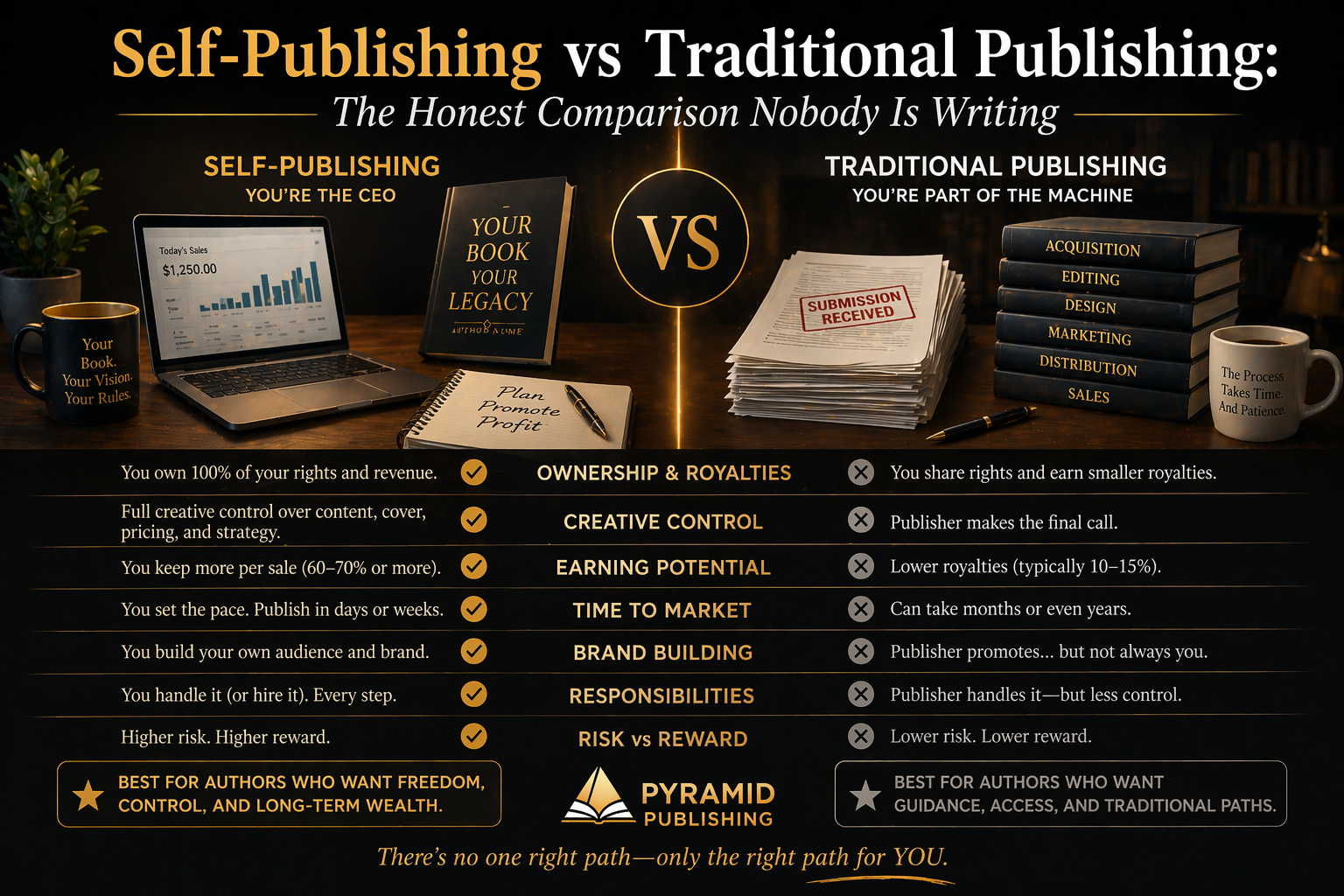
Every article comparing self-publishing and traditional publishing has an agenda. The traditional publishing advocates want you to believe that a book without a major imprint behind it is a vanity project. The self-publishing evangelists want you to believe that traditional publishing is a dying industry staffed by gatekeepers who are afraid of your brilliance. Both positions are wrong, and neither gives you the information you actually need to make the best decision for your book. This article is the comparison nobody writes, because it requires saying things that are uncomfortable for both camps. It requires acknowledging that traditional publishing has genuine advantages that self-publishing cannot replicate, while simultaneously acknowledging that self-publishing, done professionally, is not just a viable alternative but in many cases the superior choice. At Pyramid Publishing, we work with authors across both paths. Our professional self-publishing service produces books that compete directly with the best traditionally published titles in terms of production quality, distribution reach, and commercial performance. Our best-selling marketing campaigns deliver results that most traditional publishers’ marketing departments cannot match for mid-list authors. We have no stake in which path you choose, only in helping you make the right one and execute it brilliantly. What Traditional Publishing Actually Offers Advance Payments The most tangible advantage of a traditional publishing deal is the advance, an upfront payment against future royalties that provides financial support during the writing process. For a first-time author with a compelling proposal, advances range from modest to life-changing, depending on the perceived commercial potential of the book. What most publishing guides do not adequately explain is that most advances, for all but the very top tier of authors, are not life-changing. The median advance for a non-fiction book from a mid-size traditional publisher is closer to a consulting day rate than a salary. And the advance must be earned back from royalties before additional royalty income is generated, which means many authors who receive an advance never see a royalty check beyond it. Bookstore Distribution Traditional publishers have established relationships with major bookstore chains that give their titles preferential physical placement. This is a genuine advantage, particularly for books whose readers still browse physical bookshops, and it is one that self-publishing services cannot match at the highest tier. However, the gap between traditional and professional self-publishing distribution has narrowed significantly. Pyramid Publishing‘s professional book distribution service places your book with IngramSpark and other wholesale networks, making it available for ordering by any bookshop worldwide and placing it in the same databases that traditional publishers use for library and retail supply. Automatic shelf placement in major chains is not guaranteed, but the infrastructure for it exists. Prestige and Credibility A book published by Penguin, Macmillan, or HarperCollins carries a credibility signal that self-publishing cannot replicate. For academics, some journalists, and professionals whose target audience places significant weight on traditional publishing credentials, this prestige matters in ways that are genuinely career-relevant. For most professional authors, executives, entrepreneurs, coaches, consultants, thought leaders, the prestige differential is considerably less significant. Their readers judge a book by its quality and its usefulness, not by its imprint. A professionally produced self-published book is functionally indistinguishable from a traditionally published one in all the ways that matter to this audience. Editorial Support The best traditional publishers provide exceptional editorial support, developmental editors who work deeply with manuscripts, copy editors with encyclopedic knowledge of style and consistency, and production teams who apply decades of institutional knowledge to every formatting decision. This editorial support is available outside traditional publishing too. Pyramid Publishing‘s professional manuscript editing service provides the same depth of editorial expertise, developmental editing, structural editing, copy editing, and proofreading, without requiring you to sign away your rights or wait eighteen months for a publication date. What Traditional Publishing Costs You Your Rights When you sign a traditional publishing contract, you are typically signing away the majority of the rights to your book, often for the duration of the copyright, which in most jurisdictions extends seventy years beyond the author’s death. This includes print rights, digital rights, audio rights, translation rights, film and television rights, and in some cases, merchandising rights. The commercial value of these rights depends entirely on the book’s success. If the book succeeds beyond expectations, you have given away most of the upside. If it underperforms, you may find it difficult to reclaim rights to a book that is no longer being actively sold. Your Timeline The traditional publishing timeline is long. Query submission, agent representation, publisher interest, contract negotiation, editorial development, production, and physical distribution typically takes between eighteen months and three years from manuscript submission to bookshop shelf. For an author with a time-sensitive message, a professional event to launch at, or a business opportunity that a published book would unlock, this timeline is prohibitive. Pyramid Publishing‘s professional self-publishing package takes a finished manuscript to a published, globally distributed book in as little as eight to twelve weeks. Your Royalties Traditional publishing royalties for print books typically range from 7.5% to 15% of the cover price, depending on the contract and the publisher. Digital royalties are somewhat higher, typically 25% of net receipts. Self-publishing platforms, by contrast, offer royalty rates of 60% to 80% on digital editions and 40% to 60% on print. The royalty differential is significant and is one of the most consistently underweighted factors in the traditional versus self-publishing comparison. An author selling the same number of copies through a professional self-publishing service will, in most scenarios, earn considerably more per sale than through a traditional publisher. Your Control Traditional publishing involves significant compromises on creative control. Cover design, interior layout, pricing, marketing strategy, publication date, and in some cases even editorial content are subject to the publisher’s preferences and commercial considerations. Authors who have strong views about how their book should look, feel, and be positioned frequently find the traditional publishing process frustrating. Self-publishing through Pyramid Publishing gives you complete creative control over every dimension of your book, with

The Difference Between a Good Ghostwriter and One Who Captures Your Soul!
There are a lot of ghostwriters in the world. There are writers who can produce clean, professional prose on almost any subject. Writers who can meet a deadline, follow a brief, and deliver a manuscript that is technically competent and perfectly readable. And then there are ghostwriters who do something rarer and more valuable: they capture you. Not just your ideas, your presence. The way you think. The rhythm of your reasoning. The specific texture of your personality as it expresses itself through language. The result is a book that readers finish and say: I feel like I know this person. And they are right. The difference between these two kinds of ghostwriting is the difference between a book that does its job and a book that changes things. At Pyramid Publishing, we build our ghostwriting matching process around finding the second kind of writer for every author we work with. Here is how to recognise the difference, and why it matters enormously for your book. What Good Ghostwriting Looks Like Good ghostwriting is not nothing. It is considerably better than most authors could produce on their own. A good ghostwriter takes your material and turns it into readable, well-structured, professionally polished prose. The argument is clear. The chapters flow. The book is publishable. But good ghostwriting produces a book that sounds like a generic version of you, competent, credible, and slightly colourless. It delivers your ideas without your personality. It communicates your expertise without your distinctive way of seeing things. Readers appreciate it. They learn from it. They do not remember the author’s voice when they put it down. This is the ceiling of technical ghostwriting. It is where most ghostwriting services operate. It is not where Pyramid Publishing aims. What Soul-Capturing Ghostwriting Looks Like “A great ghostwriter does not just write your book. They find the version of you that only exists in your best moments and make it permanent.” Soul-capturing ghostwriting does something technically harder and humanly more significant. It produces a manuscript that sounds like you, not the average you or the professional-presentation you, but the version of you that emerges when you are at your most articulate, your most honest, your most engaged with an idea that genuinely matters to you. This version of you is the one your closest colleagues experience in the best conversations. The one that comes out when you are teaching something you deeply believe in. The one that makes people lean forward and put down their phones and listen. Soul-capturing ghostwriting puts that version of you on the page and keeps it there for every reader, in every country, for every year the book is in print. The Technical Skills That Separate Them Voice Analysis at Depth A good ghostwriter captures your surface voice, the words you use, the length of your sentences, the formality of your register. A great ghostwriter, like those at Pyramid Publishing, goes deeper. They capture your rhetorical patterns, the way you build an argument, whether you lead with a conclusion or work toward one, whether you favour questions or assertions, how you use humour, and how you recover from an emotional point before moving to a technical one. Emotional Intelligence in Interviewing The depth of a ghostwritten book is determined by the depth of the discovery interviews. A good ghostwriter asks thorough questions. A great ghostwriter asks the question after the question, the follow-up that goes beneath the professional answer to the human experience underneath it. They create the safety for an author to go to places in their story that reveal something real, something vulnerable, something that turns a professional account into a human one. The Ability to Hear What Is Not Said The most important material in any ghostwriting project is often the material the author initially does not think to mention, because they are so close to it, because they assume the reader already knows it, or because they have not yet recognised its significance. A great ghostwriter identifies these gaps through careful listening and strategic questioning. They build the book from both what you say and what you have not yet said. Structural Intuition There are many ways to structure any given book. A good ghostwriter builds a logical structure. A great ghostwriter builds a structure with emotional as well as logical momentum, one that makes the reader feel compelled to continue not just because the argument is clear but because the narrative has a pull, a shape, a satisfaction that rewards persistence. How to Know Which Kind of Ghostwriter You Are Getting There are several reliable signals that distinguish a soul-capturing ghostwriter from a technically competent one. Ask to See Voice Samples Before engaging any ghostwriting service, ask to see samples of books they have produced for authors in adjacent genres or industries. Read a chapter and ask: does this sound like a real, specific person? Or does it sound like a professional voice that could belong to anyone? At Pyramid Publishing, we are proud to show prospective clients examples of the voice range our ghostwriters can capture and reproduce. Evaluate the Discovery Process The sophistication of a ghostwriter’s discovery process is a reliable proxy for the depth of the work they will produce. A ghostwriter who asks only functional questions, what is the book about, who is it for, what are the chapters, is working at the surface. A ghostwriter whose questions go to your motivations, your fears, your origin story, your relationship with failure, your definition of success, is working at the depth that produces a book worth reading. Trust Your Response to Their Questions In your first session with a potential ghostwriter, pay attention to how you feel when they ask questions. Do you find yourself giving the answers you always give? Or do you find yourself surprised by what comes out, saying things you have not quite said before, making connections you have not consciously made? The ghostwriter who surprises you into honesty is the