

You spent months, maybe years, writing your book. You published it. You told your friends. You posted about it twice on LinkedIn. And then you waited for the sales to come. They didn’t. Or not enough of them. And now your book is sitting somewhere between page three and page thirty of its Amazon category, being seen by nobody, changing no lives, building no authority, generating no leads. This is not your fault. This is a knowledge gap, and it is one that Pyramid Publishing closes for authors every single day through professional, results-driven, done-for-you book marketing services built specifically for this moment. Here is the truth that every author needs to understand before they publish another page: a book does not sell because it is good. A book sells because it is visible. Visibility is not an accident. It is a strategy, a budget, and a professional team executing both. The Biggest Myth in Publishing The myth goes like this: write a great book, and readers will find it. Word of mouth will do the rest. The quality will speak for itself. This myth has buried more good books than bad marketing ever has. It is the reason thousands of genuinely brilliant, life-changing, career-defining books are sitting in digital obscurity right now with fewer than twenty reviews, a flat sales graph, and an author who has given up checking their dashboard. Quality is the entry requirement. Visibility is the competition. And visibility does not happen by accident. It happens when you order a professional book marketing campaign from a team that knows exactly how to engineer it. “The best book in the world, undiscovered, changes nothing. The book that gets seen changes everything.” What Actually Moves Copies, The Real Mechanics 1. Strategic Amazon Optimisation The first thing any serious book marketing service does is audit your Amazon listing. Your title, subtitle, description, backend keywords, categories, and pricing all affect whether Amazon’s algorithm shows your book to readers who are searching for exactly what you wrote. When you order an Amazon SEO package for your book, you are not tweaking metadata; you are reprogramming how Amazon decides who sees your book. 2. Paid Advertising That Targets Actual Buyers Amazon Ads, Facebook Ads, and Instagram Ads are the three most effective paid channels for book sales. But running them profitably requires expertise that most authors do not have. When you hire a professional book advertising service, you get campaigns built on proven structures, targeting your exact reader demographic, with budgets managed to maximise return on every pound and dollar spent. 3. Review Generation Campaigns Reviews are currency. A book with fewer than twenty reviews is invisible to most buyers. A book with two hundred verified reviews from real readers is a book that the algorithm promotes, that media pays attention to, and that readers trust before they have read a single page. Our professional review generation service builds your review count through ethical, platform-compliant ARC distribution, early reader outreach, and reader community engagement, creating the social proof your book needs to perform at every stage of its commercial life. 4. Media Outreach and Press Coverage A single article in the right publication, a single podcast appearance with the right audience, a single review from the right blogger, these are visibility events that advertising cannot replicate. Our book PR and media outreach service places your book in front of journalists, podcast hosts, and influencers whose audiences are your readers. 5. Social Media Marketing for Authors Social media does not sell books directly. It builds the ambient awareness that makes readers say yes when they finally encounter your book in a more purchase-oriented context. Our social media marketing service for authors manages your author presence across Instagram, Facebook, LinkedIn, and TikTok, building the audience that amplifies every other marketing activity you invest in. ✦ Quick Action• Order a professional book marketing campaign today at PyramidPublishing.co.uk • Buy a done-for-you Amazon advertising package for your book • Hire a book marketing team that moves real copies • Get a quote for a full-scale book launch marketing service The Compounding Effect of Professional Marketing Here is what separates a professional book marketing campaign from a few social media posts: compounding. Every review earned makes the next sale more likely. Every ranking improvement increases organic visibility. Every media appearance drives search volume for your name and title. Every advertising campaign generates data that makes the next campaign more efficient. When you purchase a full-service book marketing package from Pyramid Publishing, you are not paying for a one-time sales spike. You are investing in an ecosystem of visibility that grows and compounds over months and years. Our clients consistently tell us that the professional opportunities generated by their books, speaking invitations, consulting contracts, partnership proposals, and media requests far exceed what they expected when they first decided to invest in professional marketing. The book was the asset. The marketing campaign was the engine that made the asset work. “The authors who invest in professional marketing don’t just sell more books. They build entirely different careers.” What You Lose by Waiting Every month your book sits without a professional marketing campaign behind it is a month of compounding opportunity cost. The reviews that are not accumulating. The rankings are not improving. The readers who are not finding you. When you book a free marketing consultation with Pyramid Publishing today, you begin reversing that cost immediately. We offer a free, no-obligation consultation for every author enquiry. In that conversation, we will assess your current book position, identify the specific opportunities your marketing is missing, and present a clear campaign plan with projected outcomes Stop Waiting. Start Selling. Professional book marketing that moves real copies, done for you. → Order Your Book Marketing Campaign at PyramidPublishing.co.uk ←

What Traditional Publishers Won’t Tell You About the Self-Publishing Revolution
The traditional publishing industry has a significant institutional interest in maintaining the perception that self-publishing is a second-tier option, the route taken by authors who could not get a real publisher, producing books that belong in a different, lesser category from the titles that major houses produce. This perception is increasingly difficult to sustain, because the evidence against it is mounting in ways that even the most traditional voices in publishing cannot easily dismiss. Self-published books are winning awards. Self-published authors are outearning their traditionally published peers. Self-published titles are appearing on bestseller lists that were once exclusively the domain of the major imprints. Here is what traditional publishers are not telling you about the transformation that is reshaping their industry, and why professional self-publishing services like those offered by Pyramid Publishing represent not just a viable alternative but, for many authors, the superior choice. The Quality Gap Has Closed The most fundamental argument for traditional publishing was always quality. Major publishers had the editorial resources, the design expertise, and the production standards to produce books that were simply better than anything a self-published author could achieve. This argument was valid for decades. It is no longer valid for authors who invest in professional self-publishing support. The editorial depth available through professional freelance editing services matches the quality of in-house editorial teams at all but the very top tier of traditional publishers. The cover design capabilities of specialist book designers exceed the work of many in-house design departments. The typesetting quality available through professional self-publishing services is indistinguishable from the best traditionally published books. The quality gap that once justified the significant trade-offs of traditional publishing has largely closed. Pyramid Publishing‘s professional publishing service produces books that compete with any traditionally published title in terms of production quality, and the authors of those books retain rights and royalties that no traditional publisher would offer. The Distribution Monopoly Has Broken Traditional publishers’ second most powerful argument was distribution. Only they had the relationships with major retailers, the infrastructure to supply libraries at scale, and the international networks to place books in markets worldwide. This is no longer true. The rise of Amazon as a primary book retail channel, the global reach of digital distribution through ebook platforms, and the availability of professional wholesale distribution through IngramSpark have collectively broken the traditional publishers’ distribution monopoly. A book published through Pyramid Publishing‘s professional publishing and distribution service has access to the same retail channels, the same library supply networks, and the same international distribution infrastructure as any traditionally published title. The distribution advantage that once made traditional publishing essential has been democratised. The Marketing Support Was Always Less Than Promised One of the most consistently disappointing experiences for first-time authors who sign with traditional publishers is the discovery that the marketing support they were promised, the publicity campaigns, the bookshop promotions, the media outreach, rarely materialises at the level they expected. Traditional publishers concentrate their marketing resources on their top-tier titles, the celebrity memoirs, the major franchise authors, the books with significant advance investments. Mid-list authors, which includes the majority of first-time business and professional non-fiction authors, frequently receive minimal marketing support. The honest truth is that Pyramid Publishing‘s professional best-seller marketing campaigns deliver more targeted, more measurable, and more commercially effective marketing than most mid-list authors receive from traditional publishers. When you buy a best-seller marketing campaign from us, you are investing in marketing that is specifically designed for your book, your audience, and your commercial goals, not a generic publicity template applied across fifty titles simultaneously. The Royalty Structure Is Designed for the Publisher’s Benefit Traditional publishing royalty structures have not changed significantly since the mid-twentieth century. Authors receive between 7.5% and 15% on print copies and around 25% on digital copies, structures that made sense when publishers bore all the production, distribution, and marketing costs and when print was the only format. In a world where print-on-demand eliminates upfront production risk, digital distribution eliminates physical inventory costs, and self-publishing authors can manage their own marketing, the traditional royalty structure represents an increasingly difficult-to-justify transfer of value from the author to the publisher. Pyramid Publishing‘s professional self-publishing model returns royalties of 60% to 80% on digital editions and 40% to 60% on print copies, rates that reflect the actual value distribution in a modern publishing model. Over the commercial life of a successful book, the royalty differential between traditional and professional self-publishing represents significant income that stays with the author. The Rights Situation Is More Important Than Authors Realise The rights implications of a traditional publishing contract are among the most significant and least understood aspects of the decision to sign with a traditional publisher. Authors who sign broad rights agreements, covering print, digital, audio, translation, and subsidiary rights, are potentially signing away the majority of their book’s commercial value for the duration of the copyright. In a world where audio rights have become a significant revenue stream, where translation rights represent major income for successful books, and where adaptation rights can generate income orders of magnitude beyond book royalties, the decision to sign those rights away should be made with clear eyes about what is being transferred. Pyramid Publishing‘s professional self-publishing service leaves all rights with you. Audio rights. Translation rights. Adaptation rights. International rights. Every commercial opportunity your book creates belongs entirely to you. “Traditional publishers will not tell you that the advantages they offer have narrowed while the costs they impose have remained. Professional self-publishing has changed the calculation.” The Conclusion Traditional Publishers Hope You Never Reach For the right author, the executive, the entrepreneur, the expert, the thought leader writing for a professional audience, professional self-publishing is not a consolation prize. It is the superior commercial choice. Higher royalties. Retained rights. Faster timeline. Complete creative control. Access to the same distribution infrastructure and superior marketing support. The decision to publish professionally through Pyramid Publishing is the decision to access every advantage that publishing can offer while

Why Most Authors Launch Their Books Wrong? & How to Do It Right?
The majority of book launches fail. Not because the books are bad. Not because the market is oversaturated. Not because readers don’t want what those authors have written. They fail because the authors launching them are making the same predictable, preventable mistakes, mistakes that a professional book launch team fixes before the launch begins. At Pyramid Publishing, we have seen every version of a failed launch. And we have seen what a professionally executed book launch campaign looks like when every mistake is avoided and every opportunity is seized. The difference is not marginal. It is transformational. Mistake One: Launching Without Reviews The single most common and most damaging launch mistake is going live on Amazon with fewer than twenty reviews. Reviews are the primary conversion signal for book buyers. A book with no reviews is a book that most readers scroll past without clicking. A book with fifty reviews from real readers is a book that buyers trust before they read the description. The fix is an ARC distribution and review generation campaign that begins four to six weeks before launch. When you order a pre-launch review package from Pyramid Publishing, you arrive on launch day with social proof already in place, and the algorithm already paying attention. Mistake Two: Choosing the Wrong Amazon Categories Most authors choose their Amazon categories based on what their book is most broadly about. This is the wrong approach. The right approach is to identify the specific subcategories where a concentrated launch push will generate a best-seller ranking, creating a credibility signal that drives further organic discovery. Our Amazon category research and optimisation service identifies exactly which categories give your book the best ranking opportunity and sets up your listing to compete for and win those positions from day one. Mistake Three: No Pre-Launch Buzz A book that launches cold, with no pre-existing awareness among its target audience,is starting with a significant disadvantage. A professionally managed pre-launch book marketing campaign builds anticipation, grows your email list, warms your social media audience, and generates search demand for your title before it is available to purchase. Pre-orders matter. Pre-launch email list building matters. Pre-launch social content matters. Every reader who knows your book is coming before it arrives is a guaranteed sale on launch day. Professional launch management builds that audience systematically. “A cold launch is a missed launch. The best book launches are warm before they begin.” Mistake Four: Stopping After Week One The most common pattern in self-managed launches: a flurry of activity in week one followed by silence. Sales spike briefly, then collapse. The algorithm, which responds to sustained velocity rather than one-time spikes, never picks up the title for organic promotion. The book falls out of its ranking and stays out. Our sustained book marketing packages maintain campaign activity for four to eight weeks,the minimum required for algorithmic momentum to build. Mistake Five: No Professional Cover or Listing A book with an amateur cover and an unoptimised listing converts at a fraction of the rate of a professionally presented title. Before you spend a single penny on advertising, you need a professional book cover design, a compelling keyword-rich description, and a listing that makes the strongest possible case for a reader to click buy. Our book listing optimisation service and professional cover design package exist for exactly this reason. ✦ Quick Action • Order a pre-launch book marketing campaign at PyramidPublishing.co.uk • Buy a professional book cover design package today • Hire a book launch team that eliminates launch mistakes • Get a quote for a sustained 8-week book marketing campaign How to Do It Right ,The Pyramid Publishing Launch Blueprint When you order a professional book launch package from Pyramid Publishing, here is what you get: a pre-launch review campaign, a fully optimised Amazon listing, a professional cover if needed, a coordinated multi-channel advertising campaign, media outreach, social media management, and a dedicated campaign manager who oversees every detail from six weeks before launch through four weeks after. This is not a template. It is a custom campaign built around your specific book, your specific audience, and your specific commercial goals. Every decision is informed by data. Every channel is chosen based on where your readers actually spend their time. The authors who launch this way do not just have better launch weeks. They have better careers. Book a free launch consultation with Pyramid Publishing today and let us build the launch your book deserves. Launch Your Book the Right Way Professional launch management from pre-launch through post-launch, done for you. → Book Your Launch Consultation at PyramidPublishing.co.uk ←

What It Feels Like to See Your Name on a Bookshelf for the First Time
There is a specific geography to the experience. You walk into the bookshop, perhaps one you have visited hundreds of times, where you have spent Saturday mornings running your fingers along spines and pulling out books that looked interesting and reading the first page standing in the aisle. You know this shop. You know where things are. But today you are looking for something you have never looked for before. You are looking for yourself. You find the section. You scan the spines. You find the shelf. And there, between two books by authors you have read, in the same physical space where books you have loved have lived, is a book with your name on it. This moment is available to you. It is not available only to people with major publishers and famous names and extraordinary lives. It is available to any professional with a story worth telling and the willingness to work with a professional ghostwriting, publishing, and distribution team that can put your book exactly where it belongs. Pyramid Publishing puts books on shelves. And this article is about what happens when they get there. The Geography of the Moment The moment of seeing your name on a bookshelf is physical before it is emotional. Your eyes scan, register, stop. The particular configuration of letters that is your name does something different when it appears on a spine than it does on a screen or a document. It has a permanence, an embossed, ink-and-paper solidity, that digital representations cannot replicate. You pull the book out. You turn it over. You open it. These gestures, which you have performed thousands of times with other people’s books, feel different when they are directed at your own. The familiarity of the action, book out, front cover, back cover, open, first page, is inhabited by a feeling that has no familiar name but that is something in the vicinity of wonder. “Standing in a bookshop with your name on a spine is one of those experiences that confirms you are living the professional life you were aiming for when you started.” What the Shelf Placement Signals Being on a bookshop shelf is a signal. It signals that your book has passed a professional threshold, that it has been produced to a standard that a trained retail buyer was willing to stock. For most self-published books, this threshold is not crossed. The production quality, the distribution setup, or the retail terms do not meet the standard that booksellers require. Pyramid Publishing‘s professional publishing and distribution service is specifically designed to meet every requirement for retail placement. The production quality is indistinguishable from traditionally published titles. The distribution is set up through IngramSpark with the retail discount terms that make bookshop ordering commercially viable. The cover is designed by specialists who understand what retail buyers look for. When your book is on a shelf, it is not there because someone did you a favour. It is there because it met the professional standard. That is a different and more valuable kind of arrival. The Conversations That Follow The first conversation about a bookshop placement often happens by accident. A colleague mentions they saw your book while browsing. A client texts a photograph of the spine. A family member is surprised to find it while shopping for something else and tells the story at the next gathering. These casual discoveries generate a specific kind of professional endorsement that direct promotion cannot create. When someone encounters your book in a bookshop, not because you told them about it or sent them a link, but because it was simply there, in the natural flow of their reading life, the discovery has an authenticity that changes how they think about you. You are not just someone with a book. You are someone whose book is in bookshops. The distinction is small and enormous simultaneously. The Library, A Different Kind of Shelf The bookshop shelf is the most visible placement. The library shelf is, in some ways, the most significant. A book in a library collection is a book that an institution has decided is worth preserving and making available to its community. It is a book that will be found by readers who were not looking for it specifically, who browsed, stopped, read the back cover, took it home, and returned weeks later to recommend it to the librarian. Pyramid Publishing‘s library distribution service ensures your book is available for acquisition by public, academic, and specialist libraries worldwide. The Online Shelf, Reaching Beyond Physical Geography The most significant shelf in the contemporary book market is not made of wood. It is the Amazon search results page, the digital shelf where most readers discover most books. Pyramid Publishing‘s Amazon SEO and listing optimisation service ensures your book appears on this shelf in the most competitive possible position, with the keywords, the categories, the description, and the metadata that make it discoverable by the readers who are actively looking for exactly what you have written. The physical bookshop shelf is the most emotionally significant. The online shelf is the most commercially significant. Professional publishing and distribution ensures you are on both. How to Get Your Name on the Shelf The path from no book to bookshelf has a specific sequence, and every step of it is covered by Pyramid Publishing‘s complete professional publishing service. Ghostwriting produces the manuscript. Professional editing prepares it for publication. Cover design creates the object that retail buyers will stock. Interior formatting produces the print-ready files. Publishing and ISBN registration sets up the distribution infrastructure. IngramSpark distribution puts your book in the wholesale catalogue that bookshops order from. And the best-seller marketing campaign creates the visibility that generates the reader demand that makes stocking your book an attractive proposition for retail buyers. Every step is handled. Every professional standard is met. Your name on a bookshelf is not a dream. It is the result of a process. Order your professional publishing package from

For Everyone Who Has Said “I Should Write a Book Someday”, Today Is That Day
Someday is the most expensive word in the professional vocabulary. It costs more than any failed investment, any poor hiring decision, any strategic misstep. It costs in compounding opportunity, in the career trajectory that would have looked different if someday had become today, three years ago. If you have said I should write a book someday, you are in the company of millions of professionals who have exactly the ideas, the experience, and the expertise to write a book that would matter to its readers. The difference between the ones who write the book and the ones who keep saying someday is not intelligence. It is not ambition. It is almost never even a lack of time or a lack of skill. It is the absence of a clear, supported, professionally guided path from here to there. And that path now exists, completely and professionally, through the ghostwriting, publishing, and marketing services offered by Pyramid Publishing. This article is for everyone who has been saying someday. It is a direct, practical, step-by-step account of what happens when someday becomes today, written specifically for the person who is almost ready to make the decision but needs one more push, one more piece of clarity, one more answer to the question that has been keeping them on the side of someday instead of the side of action. Pyramid Publishing is ready. The question is whether you are. What You Are Waiting For, And Why the Wait Is Costing You The professionals who have been saying someday for more than a year are waiting for something. Usually they are waiting for one of the following: a clearer sense of what the book should say, a less busy professional period, a level of writing confidence they do not currently have, or a sign from the universe that the time is right. None of these things are coming in a form that will make the decision feel safe and obvious. The clarity about what the book should say develops through the process of writing it, not before. The less busy period does not materialise for people at this level of professional engagement. The writing confidence is not a prerequisite for authorship, it is an outcome of working with a professional ghostwriter. And the universe does not send signs. It sends results to the people who make decisions. The most useful reframe for the someday professional is this: you are not waiting for the right time. You are paying the cost of the wrong decision. And the right decision is available to you today, with a single enquiry to Pyramid Publishing. What Today Actually Looks Like If today is the day you decide to stop saying someday, here is exactly what happens. Today: The Consultation You book a free consultation with Pyramid Publishing. In that conversation, which is free, requires no commitment, and creates no obligation, you describe your book idea, your professional background, your timeline, and your goals. A professional who has guided hundreds of authors through this decision helps you understand what your book could look like, how long it would take, what it would cost, and what it could produce. This Week: The Clarity Following the consultation, you receive a clear proposal, a specific outline of the ghostwriting, publishing, and marketing services recommended for your project, with a timeline and a defined scope. The vagueness that has made the decision feel overwhelming is replaced by a specific, bounded plan. The book is no longer an abstract ambition. It is a project with a start date, a team, and a delivery date. This Month: The Beginning The first ghostwriting discovery sessions begin. Your writer asks the questions that have never been asked before. The material that has been waiting inside you, the stories, the frameworks, the hard-won expertise, begins to surface in the structured, purposeful context that a professional ghostwriting process provides. The book that has been someday for years starts becoming something real. This Year: The Publication Your book is published. Pyramid Publishing‘s professional publishing team produces a beautifully designed, globally distributed physical and digital book that bears your name and represents your expertise at the highest possible level. Pyramid Publishing‘s best-seller marketing campaign creates the visibility that puts the book in front of the readers who need it. The compounding begins. The Authors Who Made the Decision The most useful evidence for the someday professional is the experience of the professionals who were in exactly the same position, who had been saying someday for years, and who made the decision to act. Their accounts are consistent. They describe relief as the primary emotion of the decision, relief that the weight of the deferred intention was finally lifting. They describe excitement as the dominant experience of the early process, the discovery sessions, the first draft chapters, the emerging sense that the book was becoming real. And they describe gratitude as the primary emotion of publication, gratitude for the team, gratitude for the process, and most consistently, gratitude that they finally stopped saying someday. What they do not describe, what none of them has ever described, is regret. Not one author who has worked with Pyramid Publishing and published their book has expressed regret about having made the decision. The direction of regret is always the other way: toward the years spent saying someday instead of acting. Someday is today. Book your free consultation with Pyramid Publishing right now. Not after you finish this article. Not after you check one more thing. Right now. The conversation is free. The decision is ready. The book is waiting. “Someday is not a plan. Today is a plan. The difference between them is a single decision and a single conversation.” ✦ Make Someday Today • Book a free ghostwriting consultation at PyramidPublishing.co.uk right now • Order a professional publishing package and stop waiting • Buy a complete ghostwriting and publishing service today • Hire a professional team and turn someday into this year • Get a
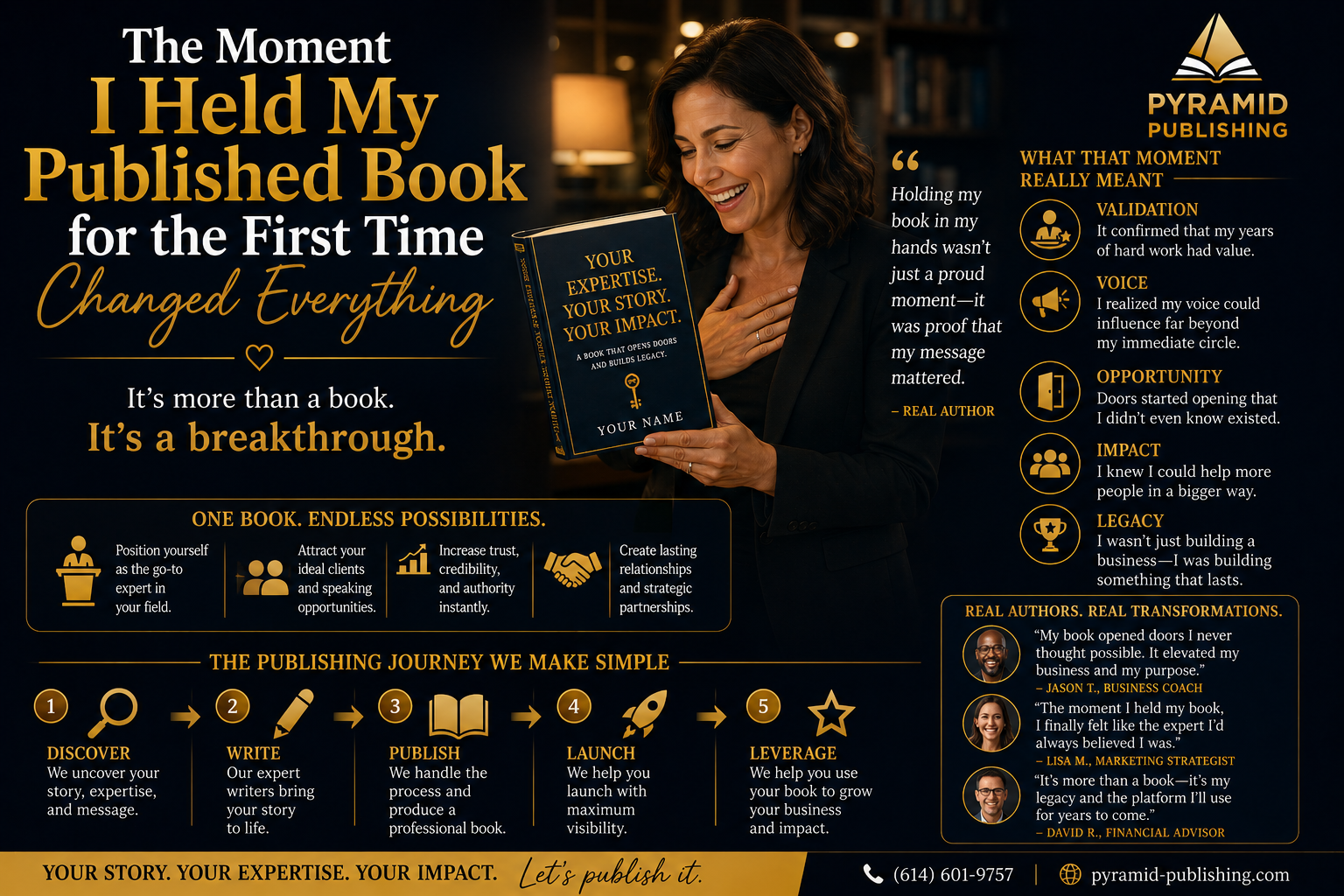
The Moment I Held My Published Book for the First Time Changed Everything
I had been warned that it would be emotional. People who had been through the process before me had tried to describe it and then, with the slightly helpless look of people trying to explain something that exceeds the available language, had settled for saying: you’ll understand when it happens. They were right. I did not understand until it happened. The box arrived on a Tuesday morning. I had not slept particularly well. I was in the middle of a busy professional week and had been trying to manage the excitement of the impending delivery with a professional calm that was mostly unconvincing. When I heard the box arrive, I sat with it unopened for almost a minute before I could bring myself to break the seal. The book inside was produced by Pyramid Publishing‘s professional publishing team. The cover design had been through three rounds of refinement. The interior had been typeset by a specialist. The paper weight, the binding, the finish, all of it had been selected with care. I knew all of this in the abstract. Holding the book, it became concrete in a way that knowing had not prepared me for. What the Moment Actually Felt Like The first feeling was surprise at the weight. Not the physical weight, the book was lighter than I expected, but the weight of what it represented. This thing in my hands was the result of decades of experience, months of work, a professional team’s skill and care, and a decision that had been both obvious and terrifying. That accumulation had a weight that the physical object carried in some way I cannot fully explain. The second feeling was something like disbelief. I opened the book to the title page and saw my name, my full name, in a typeface chosen specifically for this page, in a size and a positioning that said: this is the author. This belongs to this person. I had seen my name on documents and presentations and emails many thousands of times. I had never seen it like this. The third feeling, the one that arrived as I turned to the first page and began to read, was a kind of gratitude that I had not anticipated. Not gratitude for the book’s existence, though that was real. Gratitude for the process that had produced it, for the writer who had listened so carefully, for the publishing team that had treated every detail as if it mattered, for the marketing team that was already working to put the book in front of the readers who needed it. “Holding your published book is the moment the abstract becomes concrete. The idea you carried for years is suddenly an object in the world. It is one of the most extraordinary feelings a professional can experience.” What Changes in the Moment Something shifts when you hold a published book with your name on it. It is not a shift that can be precisely articulated, but it is a shift that every author who has experienced it will immediately recognise. The professional identity that has been building across your career suddenly has a monument, something permanent and publicly available that represents the depth of your expertise and the seriousness of your commitment to sharing it. The book is evidence of something about you that was previously implicit and is now explicit, and that shift from implicit to explicit changes how you carry yourself, how you speak about your work, and how you enter professional contexts. Authors consistently describe a change in their confidence after holding the published book for the first time. Not an arrogance, a clarity. A sense of having done something that justified the position they had always wanted to claim but had felt uncertain about fully inhabiting. The book makes the claim for them. Holding it, they feel entitled to believe it. The Production That Made the Moment Possible The moment of holding a published book is the culmination of a production process. And the quality of that production process determines whether the moment is one of pride or one of disappointment. Pyramid Publishing‘s professional publishing service is designed specifically to ensure that every author experiences the former. The Cover The cover of the book I held had been designed by a specialist with deep knowledge of the publishing category. It communicated the book’s content, tone, and target audience in a single image, in a way that my untrained eye would never have achieved. Holding it, I understood for the first time why professional cover design is a specialist discipline, because the cover I held looked like a book that deserved to be taken seriously, and I felt what that quality of design actually does to the person holding it. The Interior Opening the book to a random page and reading a paragraph was the second revelation. The typesetting was beautiful, not obviously, not theatrically, but in the way that excellent design is beautiful: invisibly, by creating an experience of reading that felt effortless and pleasurable. The line lengths, the margins, the spacing between paragraphs, all of it had been calculated to make reading easy in ways I had not previously thought about. The Object The physical book was produced to a standard that I would describe, without hyperbole, as indistinguishable from the best traditionally published books I own. The paper had weight. The binding held firmly. The cover was laminated to a finish that felt premium without feeling excessive. This was not a cheap self-published book. This was a professionally produced object that happened to bear my name. What the Moment Leads To The moment of holding the published book is not the end of the story. It is the beginning of the next phase, the phase in which the book goes out into the world and begins doing the work it was produced to do. Pyramid Publishing‘s professional best-seller marketing campaigns ensure that this phase begins immediately and builds momentum rapidly. The reviews that
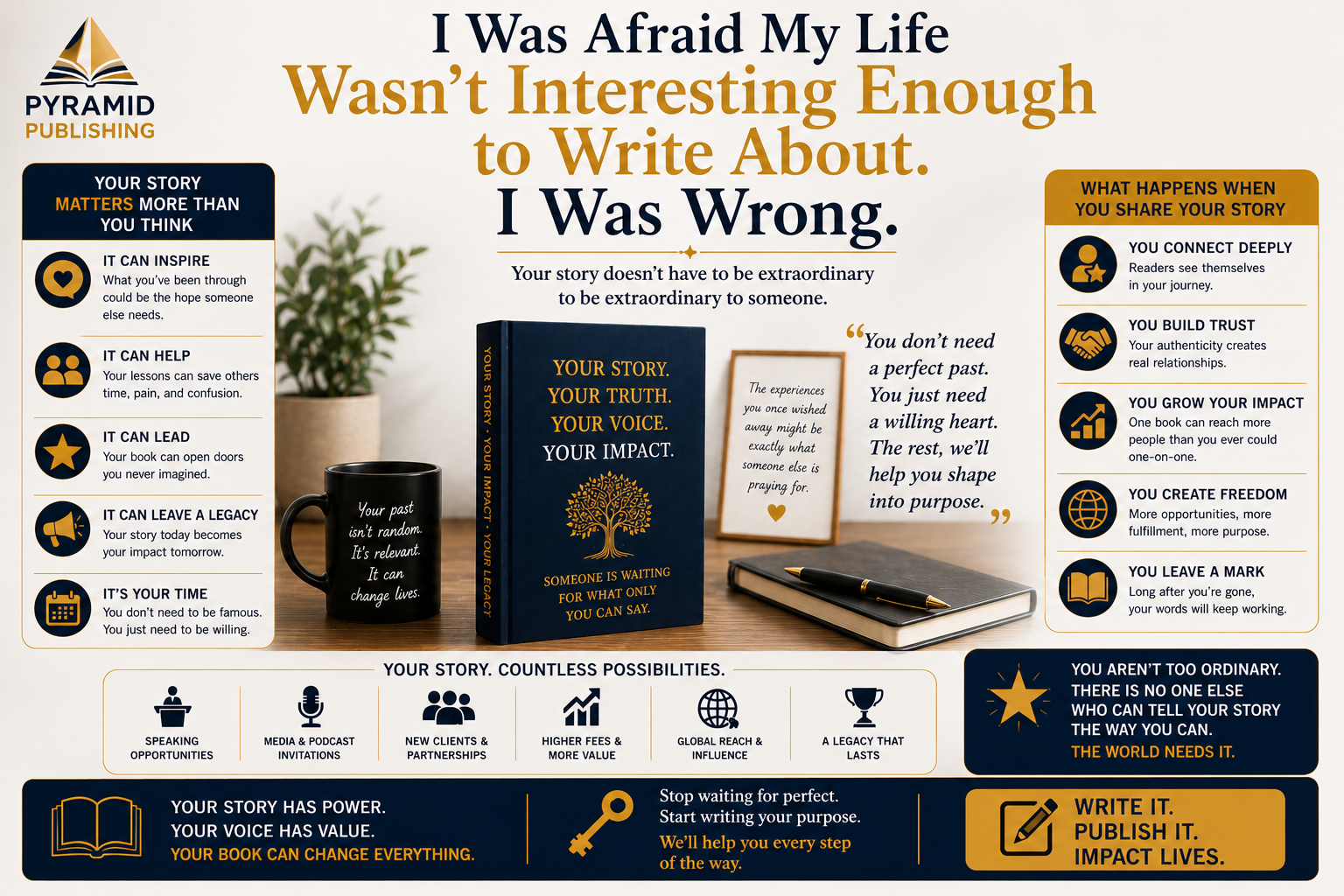
I Was Afraid My Life Wasn’t Interesting Enough to Write About. I Was Wrong.
I spent three years telling myself the same story about my story. That it was not dramatic enough. That nothing extraordinary had happened to me. That I had lived a life of quiet professional competence rather than spectacular adventure, and that this was the reason my book remained unwritten despite the fact that everyone who knew me kept telling me I should write one. The people who told me to write it were right. I was wrong. And the specific nature of my wrongness is worth examining in detail, because the belief I held about what makes a life worth writing about is one of the most common and most destructive beliefs that keeps valuable books unwritten. This is the account of how I discovered I was wrong, what happened when I finally committed to the book, and why working with a professional ghostwriting and publishing team, specifically Pyramid Publishing, made the difference between a book that existed in my head and a book that exists in the world. The Lie I Was Telling Myself The lie had a very specific shape. It went: to write a book worth reading, something extraordinary must have happened to you. You must have survived a catastrophe, achieved something historic, been in the room when something significant occurred, or been born into a life that most people would find alien and fascinating. I had done none of these things. I had built a career in a professional field over twenty years. I had made good decisions and poor ones. I had navigated relationships, raised children, lost people I loved, struggled with things I would not have chosen to struggle with, and learned things in the slow, ordinary way that most learning happens, through repeated experience rather than sudden revelation. That is what I had. I assumed it was not enough. It was more than enough. The problem was not the raw material. The problem was my inability to see its value, a failure of perspective that is almost universal among people who have lived their own life and therefore cannot see it from the outside. “We are always the worst judges of our own story. We know it from the inside, which means we cannot see what makes it valuable from the outside.” The Moment the Perspective Shifted The perspective shift happened in my first ghostwriting session with Pyramid Publishing. I went into the session with the private conviction that the writer would confirm my fears, that after hearing about my life, they would diplomatically suggest that perhaps a shorter format might be more appropriate, a blog post or an article rather than a full-length book. That is not what happened. What happened was a two-hour conversation in which an extraordinarily skilled professional asked me questions I had never been asked before, not about the dramatic events I assumed were required but about the small things, the specific decisions, the particular moments that most people overlook because they happen too quietly to be noticed from the outside. By the end of the session I had described, in answer to questions I had not anticipated, experiences that I suddenly understood were genuinely unusual, not because they were dramatic, but because of what I had noticed in them, what I had concluded from them, and what I had done with those conclusions. I had been living inside my own insight so long that I had stopped being able to see it as insight. What the Writer Saw That I Could Not Professional ghostwriters bring a specific and valuable kind of vision to their authors’ lives, the vision of an informed outside perspective encountering a story for the first time. They can see what is genuinely unusual, genuinely useful, genuinely moving in a life that its owner has inhabited so long that they can no longer see its features clearly. What my writer saw in my story, and what I could not see because I was too close to it, was a sustained argument made through lived experience. A set of conclusions, arrived at through repeated testing against reality, that the people who most needed them had no other way to access. A voice that was distinctive not because it was dramatic but because it was precise, the precision of someone who had thought carefully about specific things for a long time. That was the book. It had been there all along. I simply needed someone with the training and the outside perspective to find it, and then the professional skill to translate it into a form that readers could encounter. What Writing It Actually Felt Like The writing process, conducted by my ghostwriter from the material gathered in our discovery sessions, felt like watching someone build something from materials I had collected without knowing what they were for. Every chapter that arrived in my inbox was simultaneously familiar and surprising, familiar because it contained my ideas, my stories, my voice, and surprising because it had given them a structure and a clarity and a momentum that they had never had when they existed only inside my head. There were moments in the review process when I cried. Not from sadness but from recognition, the specific emotion of encountering something you have carried alone for a long time and suddenly seeing it clearly, fully formed, in a shape that other people can hold. The writer had not invented that emotion. They had simply found the form that made it visible. What Happened After Publication With Pyramid Publishing‘s professional publishing service producing the book and their best-seller marketing campaign creating the initial visibility, my book found readers I had never imagined reaching. Readers in different countries, different industries, different life circumstances, who wrote to tell me that something I had described as ordinary had turned out to be exactly what they needed to read. That is the outcome I had been afraid was not available to me because my life was not interesting enough. I was wrong.

Your Story Is Not Too Small, It’s Just Waiting for the Right Words
The most common reason people give for not writing their book, more common than lack of time, more common than lack of writing skill, more common than uncertainty about the process, is the belief that their story is not big enough. Not dramatic enough. Not famous enough. Not extraordinary enough to justify the space of a full-length book. This belief is almost always wrong. And understanding why it is wrong, why ordinary lives lived with attention and honesty produce books that reach people in ways that extraordinary lives lived at a remove do not, is the beginning of the decision to finally do something about the book that has been waiting inside you. At Pyramid Publishing, we have produced professionally ghostwritten and published books from stories that their authors initially described as not interesting enough to write. We have watched those books reach readers who described them as the most important books they had ever read. The gap between those two assessments is not explained by dramatic events. It is explained by the quality of the telling, and telling is what professional ghostwriting is for. The Myth of the Extraordinary Life The publishing industry has a bias toward the extraordinary, toward memoirs of survival, accounts of historic events, stories of achievement at the highest visible levels. This bias creates a distorted picture of what a book-worthy life looks like, and it causes enormous numbers of genuinely valuable stories to remain untold by people who measure their experiences against a standard that was never the right one. The stories that change lives are not exclusively the stories of extraordinary events. They are frequently the stories of ordinary lives lived with unusual clarity, the person who noticed something that most people overlooked, who found a way through a difficulty that most people give up on, who built something modest that nonetheless worked in a way that most things do not. These stories are not dramatic. They are true. And truth, told well, is what readers actually need. “Readers do not need your life to be dramatic. They need it to be honest. Honesty is rarer and more valuable than drama.” What Makes a Story Worth Telling Specificity, Not Scale The stories that resonate most with readers are not the most dramatic ones. They are the most specific ones. The specific detail that makes a scene real, the exact words someone said, the specific feeling in a particular moment, the precise texture of a decision being made, is what creates the recognition that makes a reader feel seen. Drama can be encountered in a film. Specificity can only be found in the truth of someone’s actual experience. Pyramid Publishing‘s ghostwriting discovery process is specifically designed to extract this specificity, to ask the questions that surface the concrete, particular, irreplaceable details that make your story your story and no one else’s. Honesty, Not Achievement The most powerful books are not the ones written by the most successful people. They are the ones written by people who are most willing to be honest about the reality of their experience, the difficulty as well as the triumph, the doubt as well as the conviction, the failure as well as the success. This honesty is available to anyone with a story, regardless of the scale of what they have achieved. A book about surviving a modest professional failure, told with complete honesty, can be more useful to more readers than a book about spectacular success told with the polished retrospective confidence that most success stories deploy. What readers need is not evidence that some people achieve extraordinary things. What they need is guidance on navigating the ordinary extraordinary difficulty of their own lives. Universality Through the Particular The apparent paradox of storytelling is that the more specific and particular a story is, the more universal it becomes. A story set in a specific place, at a specific time, involving specific people making specific decisions, reaches readers in every geography and every culture in ways that a generalised story cannot. The specific is the route to the universal, because readers find their own experience in the particular details of someone else’s very different situation. Your story, however local, however modest in scale, however ordinary it appears to you from the inside, contains universal elements that readers anywhere will recognise. The ghostwriting process finds these elements and builds a book around them. The result is a story that feels personal and specific and simultaneously belongs to everyone who encounters it. The Stories We Have Turned Into Books The most useful evidence that your story is not too small is the range of stories that Pyramid Publishing has helped produce into professionally published books. None of these are extraordinary lives in the conventional sense. All of them produced books that mattered deeply to the readers who found them. The scale of a story is not what determines its value. The honesty and the craft with which it is told are what matter. When you order a professional ghostwriting service from Pyramid Publishing, you are accessing the craft that makes the difference. The discovery process that finds the real story inside the story you think you have. The writing skill that turns specific truth into accessible, compelling prose. The publishing and marketing expertise that puts the finished book in front of the readers who need it. How to Know if Your Story Is Ready There is a simple test for whether your story is ready to become a book. It is not a test of drama or scale or fame. It is a test of two things. First: have you experienced something, an insight, a journey, a discovery, a way of navigating something difficult, that was hard-won and that other people are still navigating without the benefit of what you know? If yes, your story has value for readers. Second: are you willing to tell it honestly, including the parts that are not flattering, the parts that are unresolved, the

What Happens When You Finally Trust Someone With Your Story
Trusting someone with your story is one of the most significant acts a person can perform. Not the edited, curated, professionally safe version of your story that you deploy in networking conversations and LinkedIn summaries. The real one, the one with the failures that almost broke you, the decisions you would make differently, the vulnerabilities you have spent years learning to manage, and the specific, textured, complicated truth of how you came to be who you are. Most professionals carry this real story privately. They have shared fragments of it with close colleagues or trusted friends. But they have never had a reason, or a safe enough context, to offer it completely to anyone, to say: here is all of it, and I am trusting you to do something worthy with it. The ghostwriting process that Pyramid Publishing provides is one of the most consistent contexts in which this kind of trust is extended and honoured. Clients who come to us for a professional ghostwriting service often arrive expecting a transactional process, a technical extraction of information to be assembled into a book-shaped document. What they experience is something considerably more human and considerably more significant. The Moment Trust Becomes Possible Trust does not arrive instantly. It is built incrementally, through accumulated evidence that the person you are trusting is worthy of what you are about to give them. In the ghostwriting context, this evidence is built through the quality of the questions your writer asks. A ghostwriter who asks generic questions, what is your background, what is the book about, who is your target reader, is not building trust. They are collecting information. A ghostwriter who asks specific, thoughtful, sometimes uncomfortable questions, what was the moment everything almost collapsed, what do you know now that you wish someone had told you at the beginning, what is the thing you have never said publicly but that is true, is doing something different. They are signalling that they can handle the real thing. The Pyramid Publishing discovery process is specifically designed to build this trust. Our ghostwriters are trained not just in information extraction but in the creation of the specific psychological safety that allows authors to tell the truth, the whole, complicated, sometimes painful truth, that makes a great book different from a competent one. What Happens in the Room When You Tell the Real Story Authors who have been through the discovery process describe a specific experience that is remarkably consistent across very different people and very different stories. It is the experience of being heard in a way they have rarely been heard before. Not heard and filed. Not heard and politely redirected. Heard and followed. Heard and asked about. Heard and treated as if the specific thing they just said was exactly the thing that needed to be said, and that the person listening was prepared to go wherever it led. This quality of listening is a professional skill of the highest order. It is the skill that separates ghostwriters who produce technically adequate books from the ones who produce books that readers finish and say: this is the most honest book I have ever read. The honesty does not come from the writer. It comes from the author. The writer creates the conditions in which honesty becomes possible. “I didn’t know how much I had to say until someone asked the right questions and then didn’t flinch at the answers.” What the Real Story Does That the Safe Story Cannot It Creates Recognition Readers read books to encounter something they recognise, an experience, a struggle, a triumph, a way of seeing something that reflects their own reality back at them with more clarity than they have been able to produce themselves. The safe story, the one that presents a polished, curated version of professional success, produces information. The real story produces recognition. And recognition is what makes a reader feel that a book was written for them. At Pyramid Publishing, every professionally ghostwritten book is built around the author’s real story, not because difficulty or vulnerability are mandatory ingredients in a great book, but because authenticity is. The version of your story that is most useful to readers is almost always the version that is most honest. It Creates Trust In a professional context, the author who is honest about failure, about uncertainty, about the things they got wrong before they got them right is the author who earns the deepest trust. Not despite the vulnerability but because of it. The reader who encounters a published author admitting something real, something that required courage to say, trusts that author’s advice about everything else. The admission is the evidence of integrity that makes everything else credible. It Creates Connection The real story creates the most valuable thing a book can create: a genuine connection between the author and the reader. Not a professional connection, not a transactional connection, but the kind of human connection that makes readers feel they know the author, that they would recognise them in a room, that they would trust them with something important. This connection is the foundation of everything a book does commercially and professionally for its author. The Fear of Trusting, And Why It Is Worth Overcoming The most common barrier to telling the real story is fear. Fear of professional judgment, that admitting difficulty or failure will undermine the authority the book is trying to establish. Fear of personal exposure, that private experiences shared publicly will create vulnerability that cannot be managed. Fear of misrepresentation, that the story will be told in a way that is not quite right, that the nuance will be lost, that the truth will be simplified into something that no longer feels true. These fears are legitimate. They deserve to be taken seriously. And they are addressed directly by the professional ghostwriting process at Pyramid Publishing. On professional judgment: the authors who are most trusted in their fields are consistently the ones who

The Book You Haven’t Written Yet Is Already Costing You Something
There is a particular kind of cost that is almost impossible to see clearly because it arrives not as a bill but as an absence. Not as something taken from you but as something that was never given to you. Not as a loss you can point to but as a gap between the professional life you are living and the one you could be living if one decision had been made differently. The cost of your unwritten book is this kind of cost. It is invisible in the day-to-day. It does not announce itself at the end of each month with a statement. It accumulates silently, in the speaking invitations that went to the author instead of you, in the consulting contracts that landed with the expert who had a book, in the readers who needed exactly what you know and found someone else’s version of it instead. This article is an honest accounting of what that cost actually looks like, specific, measurable, and actionable. And it ends with the most direct possible path to ending it: a professional ghostwriting, publishing, and best-seller marketing service from Pyramid Publishing that transforms your unwritten book from a deferred intention into a published reality. The Invisible Invoice, What the Unwritten Book Costs by Category The Speaking Cost Professional speaking is one of the most immediate and tangible sources of income and professional visibility for established experts. Conference organisers, corporate event planners, and academic institutions use published books as a primary filter when selecting speakers for keynote positions. The author gets the invitation. The equally qualified non-author does not. Calculate this cost concretely. If you speak at three events per year at a fee of £5,000 each, your speaking income is £15,000 annually. A professionally published author in your field, speaking at the tier of engagements your expertise qualifies you for, is likely earning two to four times that figure. The gap, £15,000 to £45,000 annually, compounding year on year, is a direct cost of the unwritten book. When you order a professional ghostwriting package from Pyramid Publishing and publish your book, this cost begins to reverse within months of publication. Speaking invitations arrive from organisers who find the book. Fees increase as your authority signal strengthens. The compounding that was working against you begins working for you. The Rate Cost Professional service rates are determined by perceived value. Perceived value is determined by evidence of expertise. A published book is the most comprehensive evidence of expertise available in any professional services market, and it systematically raises the rates that published authors can charge relative to equally qualified non-authors. The documented rate premium for published authors varies by industry and market, but it is consistently significant, ranging from a twenty percent uplift to, in many professional service categories, a complete repositioning in a higher fee bracket. Over a career of twenty active professional years, even a modest rate premium compounds into a financial figure that dwarfs the investment in producing a book. “The unwritten book is not free. It has a price. It is paid monthly, in the gap between the rates you charge and the rates your published peers command.” The Client Quality Cost The clients who arrive having read your book are different from the clients who arrive through conventional channels. They are pre-convinced of your approach. They are self-selected for alignment with your methodology. They are ready to commit before the first conversation. They convert at higher rates, engage at deeper levels, and generate stronger referrals. The clients you are attracting without a book are the clients available to you through your current credibility signals. The clients available to you with a published book are a different, larger, better-quality set. The difference between those two populations is the client quality cost of the unwritten book, a cost that is real and recurring for every month the decision is deferred. The Legacy Cost This cost is the hardest to quantify and the most significant in the long run. Your expertise, your experience, your stories, the frameworks you have developed and the lessons you have learned over a career, all of this exists, right now, primarily inside your head. When you retire, when your circumstances change, when your active professional life ends, most of it goes with you unless you have taken deliberate action to preserve it in a permanent form. A published book is that permanent form. It is the document that ensures your best thinking reaches the people who need it, not just during your active career but long after it. The legacy cost of the unwritten book is the expertise that will disappear rather than endure, the readers who will never encounter your ideas, the professionals who will make mistakes that your published experience could have helped them avoid. The Compounding Logic, Why the Cost Grows What makes the cost of the unwritten book particularly significant is that it is not static. It compounds. The published author’s authority grows month by month, more reviews, more media mentions, more speaking appearances, more referrals, more opportunities. The gap between their professional position and yours, if yours remains unchanged, grows with it. The professional who published two years ago has a two-year compounding advantage in reviews, in rankings, in media profile, in the algorithm-driven visibility that makes books findable. Every month of that advantage has made the next month’s advantage slightly larger. The gap is not fixed. It is growing. And the only way to stop its growth is to publish. At Pyramid Publishing, we have built our complete professional publishing service, ghostwriting, publishing, and best-seller marketing, specifically to give every author the fastest possible path from the decision to publish to the moment the compounding begins working in their favour rather than against them. The Emotional Cost Nobody Talks About Beyond the professional and financial costs is something more personal: the weight of an intention that has been carried too long without being acted upon. The book that has been