
Professional Book Proofreading Services UK | Pyramid Publishing
Hire a Proofreader for the Final, Meticulous Pass Your Book Deserves Before It Goes Live
Hire a Proofreader for the Final, Meticulous Pass Your Book Deserves Before It Goes Live
If you’ve searched “book proofreading service UK,” “hire a proofreader,” or “how to proofread a manuscript before publishing,” you’re likely at the final stretch of your publishing journey the manuscript is written, revised, maybe even edited, and now you need someone with fresh eyes to catch every last typo, punctuation slip, and formatting inconsistency before it reaches readers.
Pyramid Publishing offers professional book proofreading services for fiction, non-fiction, memoir, and business authors across the UK. This is the final quality-control layer between your manuscript and publication the pass that catches what every previous read-through missed, because by the time an author has read their own manuscript a dozen times, their brain reliably autocorrects errors without consciously noticing them. This page explains exactly what proofreading covers, how it differs from editing, and what our process looks like.
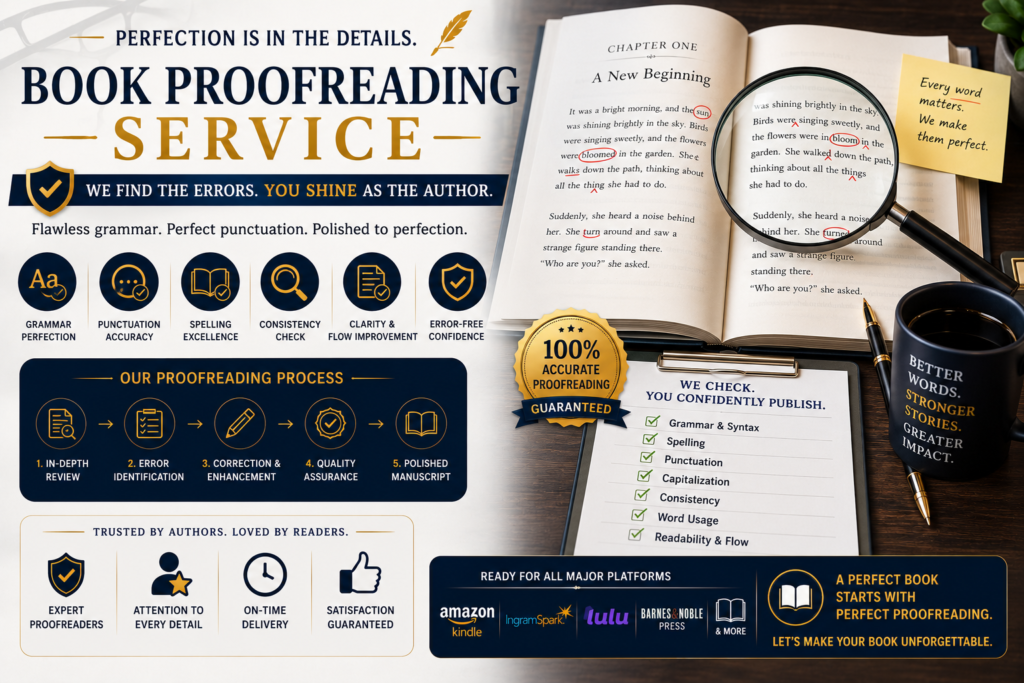
Why Authors Choose Our Proofreading Services
If you’ve been comparing “best proofreading services UK,” “freelance proofreader vs agency,” or “affordable proofreading for authors,” here’s what separates a genuinely thorough proofread from a quick skim:
- Dedicated proofreading specialists not an editor squeezing in a rushed final check between other projects
- A structured, multi-pass proofreading process, not a single read-through
- Fresh eyes on every manuscript proofreaders who haven’t read your book fifteen times and gone blind to its familiar patterns
- Consistency checking across the entire manuscript, not just sentence-by-sentence error spotting
- UK English and US English proofreading, matched to your target market
- Proofing on the final, formatted file catching layout errors introduced during formatting, not just the original manuscript text
Proofreading is detail work, and detail work suffers the moment it’s rushed or treated as an afterthought. We treat it as its own specialist discipline, not a lesser version of editing squeezed in at the end.
What Does Book Proofreading Actually Cover?
If you’ve searched “what does a proofreader check for” or “what’s included in proofreading,” here’s the precise, honest scope:
- Spelling errors, including correctly spelled words used incorrectly (their/there/they’re, its/it’s)
- Grammar mistakes subject-verb agreement, tense consistency, and sentence construction errors
- Punctuation errors misplaced commas, inconsistent quotation mark style, missing or extra apostrophes
- Typographical errors duplicated words, missing words, transposed letters
- Formatting consistency inconsistent spacing, indentation, or paragraph breaks introduced during earlier revision or formatting passes
- Capitalisation consistency proper nouns, titles, and character or place names used consistently throughout
- Hyphenation and compound word consistency ensuring the same term isn’t hyphenated one way on page 40 and another way on page 200
- Numeral consistency whether numbers are spelled out or written as digits, applied consistently per your style guide
- Widow and orphan issues in the final laid-out file (single words or lines awkwardly stranded at page breaks)
- Header, footer, and page number accuracy in the final formatted document
- Front and back matter accuracy title page, copyright page, and author bio checked as carefully as the main text
What proofreading does not cover and this distinction matters is structural feedback, plot or argument issues, rewriting clunky sentences, or substantial content changes. If those issues remain in your manuscript at the proofreading stage, that generally signals the book needed a developmental edit or copyedit first, which we’ll tell you honestly rather than attempting to proofread around unresolved structural problems.
Proofreading vs Copyediting vs Editing: What's the Difference?
This is one of the most common points of confusion for authors searching “proofreading vs copyediting” or “do I need an editor or a proofreader.” Here’s the clearest way to understand where proofreading sits in the process:
Editing (developmental and line editing) happens earliest, addressing structure, pacing, argument logic, character consistency, and prose style the substantial, creative-level work of shaping the manuscript itself.
Copyediting happens next, correcting grammar, punctuation, consistency, and style-guide adherence at a technical level, while still occasionally flagging larger clarity issues that need author attention.
Proofreading happens last after editing, after copyediting, and ideally after formatting or typesetting as the final safety-net pass on the near-final file, catching whatever slipped through earlier stages plus any new errors introduced during formatting itself.
A useful way to think about it: editing asks “does this book work?” Copyediting asks “is this technically correct and consistent?” Proofreading asks “is this exact, final file completely clean?” Skipping straight to proofreading on a manuscript that hasn’t been properly edited or copyedited first almost always produces a disappointing result, because a proofreader isn’t scoped or briefed to catch the kind of structural or stylistic issues an edit would have addressed and pushing a proofreader to do that work anyway usually means genuine proofing errors get missed while they’re distracted fixing bigger problems that were never in scope.
If you’re not sure which stage your manuscript is actually at, our free sample assessment will tell you honestly which service you need including if the answer is “proofreading isn’t the right service yet.”
Our Book Proofreading Services
- Fiction Manuscript Proofreading
For novels, novellas, and short story collections, our fiction proofreading service focuses on maintaining narrative flow while catching every technical error dialogue punctuation, consistent character name spelling, timeline consistency, and formatting accuracy throughout.
- Non-Fiction & Business Book Proofreading
Non-fiction proofreading carries additional demands beyond narrative prose. Our non-fiction proofreading service covers fact-consistency checks (not fact-verification, which is a separate research service, but ensuring the same fact is stated consistently throughout), citation formatting accuracy, and consistent terminology across technical or industry-specific content.
- Memoir & Autobiography Proofreading
Memoir proofreading requires the same technical rigour as fiction, with additional sensitivity to how dates, names, and factual details are presented consistently across a nonlinear or reflective narrative structure.
- Academic Manuscript Proofreading
For theses, dissertations, and academic non-fiction, our academic proofreading service includes citation format consistency (Harvard, APA, Chicago, or your required style), reference list accuracy, and adherence to formal academic tone conventions.
- Children’s & YA Book Proofreading
Children’s and YA proofreading requires particular attention to age-appropriate language consistency and, for picture books, ensuring proofing considers how text reads in context alongside illustrations rather than in isolation.
- Final Formatted File Proofreading
This is a distinct and important service: proofreading your final, laid-out file after formatting or typesetting rather than the original Word manuscript. Formatting and typesetting processes routinely introduce their own errors (a misplaced page break, an inconsistent header, a table of contents link pointing to the wrong page), and these can only be caught by proofing the actual final file, not the source document.
- Republished & Reformatted Book Proofreading
If you’re updating, reformatting, or relaunching a previously published book, we offer proofreading specifically for the updated file, checking that new formatting or content changes haven’t introduced new inconsistencies against the previously published version.
- Business Document & Non-Book Proofreading
Beyond books, we also offer proofreading for business documents connected to your author brand website copy, sales pages, press materials, and speaker one-sheets ensuring the same standard of polish extends across everything with your name on it, not just the book itself.
Signs Your Manuscript Needs Professional Proofreading
You’re likely at exactly the right stage for proofreading if you’re asking:
- “My manuscript has already been edited is proofreading still necessary?” (Almost always, yes editing and proofreading serve different functions and one doesn’t substitute for the other.)
- “I’ve read this manuscript so many times I can’t see it clearly anymore.”
- “How do I catch errors in my own writing when I know exactly what I meant to say?”
- “My book is formatted and ready to upload is there anything left to check?”
- “I already self-published and I’m getting reviews mentioning typos what now?”
The core challenge proofreading solves is a genuinely human limitation: authors (and even editors, on their own work) are cognitively prone to reading what they intended to write rather than what’s actually on the page, especially after repeated exposure to the same text. Fresh, professional eyes are the only reliable fix for this
How Much Does Book Proofreading Cost?
A common search is “how much does proofreading cost UK” or “proofreading rates per word.” Proofreading costs generally depend on:
- Manuscript length proofreading is most commonly quoted per word or per page, so a 100,000-word novel naturally costs more than a 30,000-word novella
- Manuscript condition a manuscript that’s already been professionally edited and copyedited requires less time (and therefore costs less) than one going straight to proofreading without prior editing stages
- Complexity of content heavily technical, footnoted, or citation-dense non-fiction typically takes longer to proofread than straightforward narrative fiction
- Turnaround time rush proofreading requests, common for authors against a launch date, typically carry a premium
- Whether you need final-file proofreading proofreading a formatted, laid-out file in addition to the manuscript text is a distinct additional pass, priced accordingly
Because proofreading is generally the least expensive of the editorial services (compared to developmental editing or line editing), it’s tempting to view it as a minor, skippable cost but it’s also the very last line of defence before your book is permanently visible to readers and reviewers, which makes it one of the highest-leverage investments per pound spent in the entire publishing process. We provide a free sample proofread on a short excerpt so you can see the level of scrutiny applied before committing to the full manuscript
Our Book Proofreading Process
Step 1: Free Sample Proofread Send us a sample chapter or excerpt, and we’ll proofread it at no cost so you can see our approach and error-catching rate before committing to the full manuscript.
Step 2: Manuscript Submission & Scope Confirmation We confirm word count, target style guide (UK or US English, specific house style preferences), and turnaround timeline.
Step 3: First Proofing Pass Your proofreader works through the complete manuscript, marking every error using track changes, so nothing is silently altered without your visibility.
Step 4: Consistency Check A dedicated pass specifically checks consistency across the full manuscript character names, terminology, formatting, and style choices catching errors that only become visible when comparing distant sections of the book against each other.
Step 5: Second Proofing Pass A second read-through catches anything missed on the first pass and verifies that no new errors were introduced by the correction process itself.
Step 6: Delivery with Full Tracked Changes You receive your manuscript with every correction visible and reversible via track changes, plus a brief summary of any recurring error patterns worth being aware of for future writing.
Step 7: Final-File Proofread (Optional Add-On) Once your manuscript is formatted or typeset, we offer a final pass on the actual laid-out file catching any errors introduced during that formatting process before you publish
Common Errors Self-Editing Authors Miss
Authors who search “why do I keep missing errors in my own writing” are usually running into a genuine, well-documented cognitive limitation, not a lack of care or attention. These are the specific patterns we see most often when authors attempt to proofread their own work:
Homophone substitutions. Words like “there/their/they’re,” “your/you’re,” and “affect/effect” are spelled correctly and pass spell-check, since the software has no way to know which meaning you intended but they’re frequently the wrong word for the sentence. The brain reads intended meaning rather than literal text, which is exactly why authors reliably miss their own homophone errors even after multiple read-throughs.
Missing or duplicated small words. Words like “the,” “a,” “of,” and “and” are so structurally routine that the brain fills them in automatically during reading, whether or not they’re actually on the page meaning a missing or accidentally duplicated small word is one of the single most common errors that survives an author’s own proofing pass, precisely because it’s so minor.
Inconsistent formatting introduced across multiple editing rounds. After several rounds of self-revision perhaps switching between UK and US spelling conventions, or changing a character’s name partway through drafting remnants of earlier versions often survive in scattered, easy-to-miss locations throughout a long manuscript.
Dialogue punctuation errors. Comma placement inside or outside quotation marks, and correctly punctuating dialogue tags versus action beats, are consistently among the most common technical errors in self-published fiction, even from otherwise strong writers.
Numbers and measurements inconsistency. Whether to spell out numbers or use numerals, and inconsistent unit formatting (e.g. switching between “10km” and “ten kilometres” within the same book), is a subtle but noticeable inconsistency readers pick up on even without consciously identifying the cause.
Serial comma inconsistency. Whether or not to use the Oxford comma is a legitimate stylistic choice, but inconsistent application throughout a manuscript sometimes present, sometimes absent reads as an error regardless of which convention you’ve chosen, because the issue is inconsistency itself, not the choice.
None of these examples reflect poor writing they reflect the simple reality that no writer can reliably proofread their own work to a professional standard, because the same cognitive processes that make writing fluent also make self-proofing unreliable.
Industry Standards We Proofread Against
Professional proofreading isn’t simply “checking for mistakes” against an author’s personal sense of correctness it’s checked against established, recognised style conventions. Depending on your manuscript and target market, we proofread against:
- New Hart’s Rules / Oxford Style Manual the standard UK reference for spelling, punctuation, and house style conventions
- The Chicago Manual of Style the most common US publishing industry standard, particularly for US-market fiction and non-fiction
- APA and Harvard referencing conventions for academic and citation-heavy non-fiction
- Genre-specific dialogue and formatting conventions publishing houses within specific genres (romance, thriller, literary fiction) often follow slightly different established norms for elements like scene-break formatting or numeral usage
Before beginning any proofread, we confirm which standard applies to your manuscript, since UK and US conventions genuinely differ on points like quotation mark style, date formatting, and certain spelling conventions (e.g. “-ise” vs “-ize” endings) applying the wrong standard consistently is itself a kind of error, even if each individual choice looks internally consistent.
Frequently Asked Questions About Book Proofreading
My manuscript has already been through a copyedit do I still need proofreading?
Yes, in almost every case. Copyediting and proofreading are sequential, complementary stages, not interchangeable services a copyedit focuses on broader technical correctness and consistency, while proofreading is the dedicated final check on the near-final file, including catching anything the copyedit missed or that was introduced afterward.
Can proofreading catch plot holes or structural issues?
No, and it isn’t scoped to. If structural issues remain in your manuscript at this stage, that indicates a need for developmental editing first we’ll flag this honestly rather than attempting a proofread that won’t actually solve the underlying problem.
How long does proofreading take?
A full-length novel typically takes one to two weeks for a thorough proofread, depending on length and complexity; shorter works or non-fiction with more content complexity may vary from this baseline.
Should I proofread the Word manuscript, the formatted file, or both?
Ideally both. Proofreading the manuscript catches text-level errors before formatting; proofreading the final formatted file catches errors the formatting process itself may have introduced. Skipping the second pass is a common reason authors discover errors only after publication.
Can you proofread a manuscript I plan to submit to literary agents, not self-publish?
Yes. A clean, error-free manuscript makes a stronger impression on agents and reduces the risk of a submission being dismissed over avoidable, distracting errors before the writing itself is even properly considered.
What’s your error-catching rate can you guarantee a completely error-free book?
No proofreader, however skilled, can honestly guarantee absolute perfection across tens of thousands of words this is a realistic industry-wide limitation, not a shortcoming specific to any one service. What we can commit to is a rigorous, multi-pass process that catches the overwhelming majority of errors and brings your manuscript to a genuinely professional standard.
Do you proofread non-English manuscripts or translated works?
We specialise in English-language proofreading (both UK and US conventions). For translated works, we recommend proofreading occur in the target language by a proofreader fluent in that language’s specific conventions, which we can help coordinate if needed.
Is proofreading cheaper than editing?
Generally yes, per word, since it’s a narrower, more mechanical scope of work than developmental or line editing. However, this doesn’t make it optional it addresses a different, equally important risk (reader-facing errors) than editing addresses (structural and stylistic quality).
Do you offer proofreading as a standalone service, or only as part of a full editing package?
Both. Many authors come to us needing only proofreading, having already completed developmental editing and copyediting elsewhere or through extensive self-revision we’re happy to proofread a manuscript at any stage without requiring you to bundle it with earlier editorial services you may not need from us.
What happens if the proofread reveals my manuscript actually needs a copyedit first?
We’ll tell you directly, with specific examples from your manuscript, rather than proceeding with a proofread that won’t genuinely serve the manuscript’s needs. This happens periodically an author believes their book is proofreading-ready, but a sample reveals recurring consistency or clarity issues better addressed at the copyediting stage. We’d rather have that conversation upfront than deliver a proofread that leaves underlying problems in place
Ready for a Meticulous Final Proofread Before You Publish?
Whether your manuscript is heading toward self-publication, literary agent submission, or a full republish of an existing title, Pyramid Publishing’s proofreading team provides the final, careful pass that catches what every earlier read-through missed.
Request your free sample proofread today and see exactly the level of detail we bring to your manuscript before it reaches readers.
Contact Us
Fill in Your Contact Details And We Shall Get Back To You Within 1-2 Hour Time Window!
Get in Touch with Us!
Reach out today and let’s turn your ideas into a book you’ll be proud of. Your story matters, let’s share it with the world. We keep you involved at every step, making publishing a transparent, empowering, and stress-free experience.
- (+1) 628-866-2100
- (+44) 7400-700-612
- pyramidpublishinguk@gmail.com
- Merchant's Quay, Salford, Salford Quays M50