Every year, someone publishes an article explaining that books are dead. That attention spans are too short. That podcasts have replaced them. That social media has made the long-form a relic. That video content, interactive courses, or AI-generated summaries have rendered the 80,000-word argument obsolete.
Every year, those articles are wrong. Not because books have not changed, the publishing landscape has transformed dramatically over the past two decades, but because the specific function that a book performs in the credibility economy is one that no other medium has yet managed to replicate.
That function is this: a book is the only communication format that signals depth, commitment, and expertise simultaneously, in a form that is permanent, universally accessible, and impossible to fake. And it is why, at Pyramid Publishing, we have built a complete ghostwriting, publishing, and best-seller marketing service for the professionals, executives, and thought leaders who understand that a book is not just content, it is the most powerful credibility signal available in any industry.
What Credibility Actually Means in the Modern Professional Economy
Credibility is not a feeling. It is a judgment, a conclusion that other people reach about whether your expertise, your character, and your track record justify trusting you with something that matters to them. In professional contexts, credibility determines who gets the speaking invitation, who wins the consulting contract, who is quoted in the article, who is invited to join the board, who is introduced to the high-value client.
Credibility is built through evidence. And the evidence that different communication formats provide varies enormously in its depth, its permanence, and its persuasive force.
A LinkedIn profile is self-reported. A website is self-produced. A podcast appearance is ephemeral, it exists in the attention of listeners for the duration of the episode and then competes with hundreds of other episodes for recall. A keynote speech is experienced by the people in the room and then lives in their memory, which is imperfect and selective. Social media content, however compelling in the moment, is designed to be consumed and scrolled past.
A book is different. A book is evidence of a different order, an argument sustained over 200 to 400 pages, supported by stories and data and reasoning, tested by the demands of coherence and completeness in a way that no shorter format requires. The person who has written a book has done something that cannot be faked: they have committed their thinking to a form that is specific, detailed, and permanently available for scrutiny. That commitment is the foundation of the credibility signal a book creates.
“A book is the only credential that demonstrates depth of thinking rather than just claiming it. That is why nothing else in the credibility economy replaces it.”
The Credibility Gap Between Authors and Non-Authors
In almost every professional field, there is a credibility gap between practitioners who have published a book and those who have not. This gap manifests in specific, measurable ways that compound over the commercial life of the book.
Access
Published authors access rooms that their equally qualified non-author peers cannot. The conference that requires a book to be considered as a keynote speaker. The media outlet that contacts authors for expert commentary. The corporate client whose procurement process includes a published works check. The academic institution that factors publication in its visiting faculty selection. These are not rare or unusual gatekeeping mechanisms, they are standard in virtually every high-value professional context.
Rates
The rate differential between professionals with published books and those without is documented across consulting, speaking, coaching, and professional services. Published authors command higher fees, not because the book magically improves their expertise, but because the book provides evidence of that expertise in a form that makes it easier for clients to justify premium pricing to themselves, their boards, and their stakeholders.
Inbound Versus Outbound
Non-authors pursue clients. Authors attract them. The published book functions as a permanent, 24-hour inbound marketing asset, one that reaches readers when they are actively seeking expertise in your subject, pre-sells your approach before any direct contact, and generates enquiries from prospects who are already convinced of your value before the first conversation.
Why Other Formats Cannot Replace the Book
The Podcast Problem
Podcasts are an excellent medium for building familiarity and warmth with an audience. They are a poor medium for establishing deep expertise. The podcast format, conversational, responsive, episodic, does not demand the kind of sustained, structured argument that a book requires. A podcast episode establishes that you know something about a subject. A book establishes that you have thought about it at length, tested your thinking against the demands of coherent argument, and are willing to stand behind that thinking in permanent form.
The Social Media Problem
Social media content is designed to be consumed quickly and replaced immediately. The attention that social media generates is shallow and competitive, every piece of content competes with every other piece for a finite supply of audience attention. A book, by contrast, commands extended, focused attention. The reader who finishes your book has spent hours with your ideas, has absorbed them, tested them against their own experience, and formed a deep, lasting impression of you as a thinker and a professional.
The Course Problem
Online courses and educational content are valuable for knowledge transfer. They are not credibility signals in the same way a book is, because anyone can create a course, the barrier to production is low, and the format does not convey the same depth and commitment that a book requires. The published book sits at the top of the content credibility hierarchy in a way that no other format approaches.
The Book as a Career Infrastructure Asset
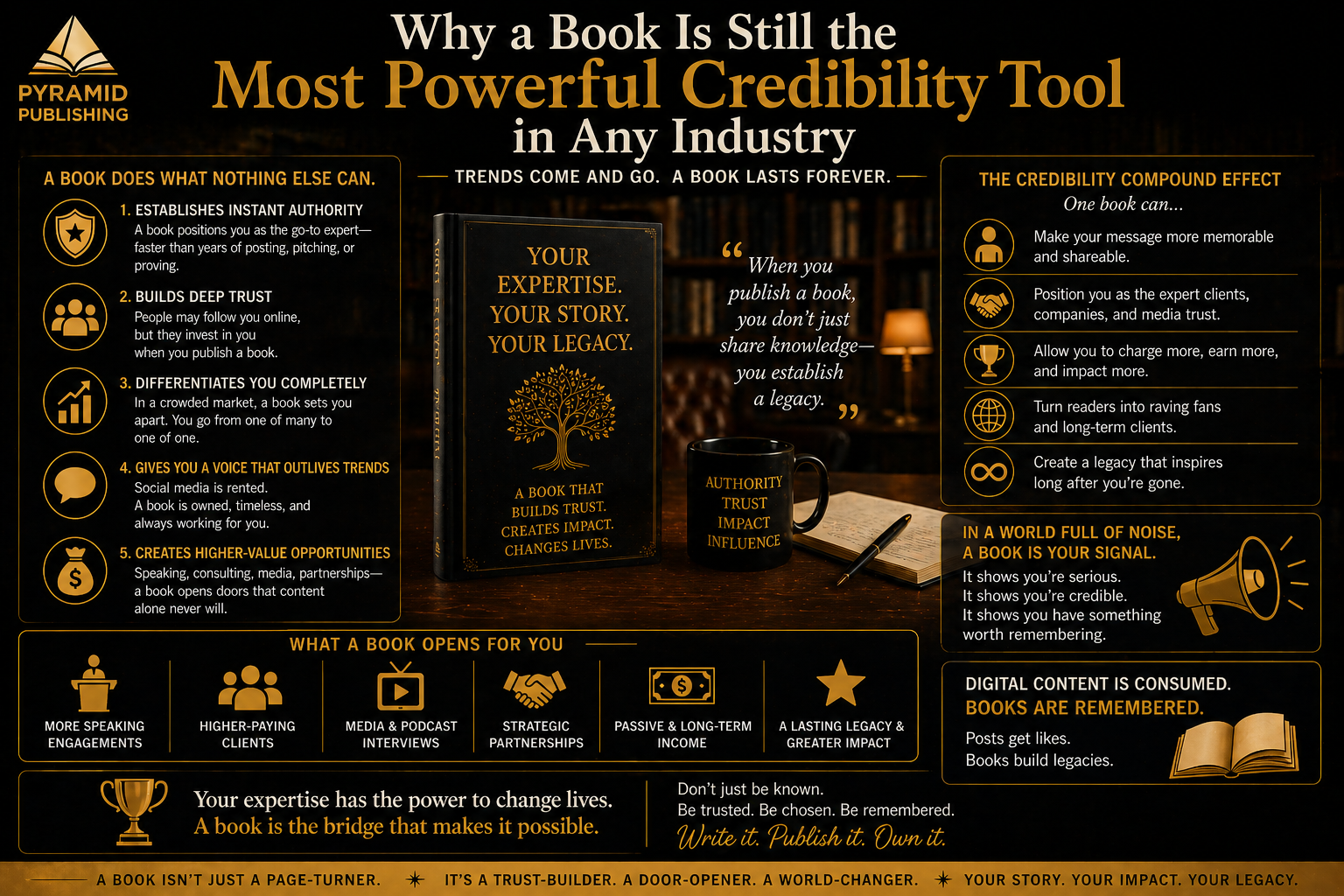
The most important thing to understand about a professionally published book is that it is not a one-time event. It is a permanent professional infrastructure asset that works on your behalf in every professional context for the rest of your career. Every reader who discovers your book, through a search, a recommendation, a media mention, a bookshop placement, is a potential client, partner, speaking invitation, or media enquiry.
This compounding effect is what distinguishes the book from every other professional investment. A marketing campaign generates results during its run. A speaking engagement creates impact for the audience that was present. A social media post performs for the hours following publication. A book performs indefinitely, finding new readers, building new relationships, and generating new professional opportunities for years and decades after the initial publication.
At Pyramid Publishing, we produce professionally ghostwritten, published, and marketed books that function as exactly this kind of infrastructure. The ghostwriting captures your expertise. The publishing gives it a form that commands respect. The best-seller marketing campaign gives it the initial visibility that starts the compounding process. And then the book works, continuously, permanently, on your behalf, while you continue building the business or career the book supports.
| ✦ Start Building Your Credibility Infrastructure Today • Order a professional ghostwriting and publishing package at PyramidPublishing.co.uk • Buy a full-service book production and marketing package • Hire a professional team to write, publish, and market your book • Get a free consultation on building your credibility through publishing • Get a quote for a complete author credibility package today |
Industries Where the Book Credibility Signal Is Strongest
While a published book enhances credibility in every professional context, there are specific industries where the signal is particularly powerful, where the gap between authors and non-authors is most pronounced and most commercially significant.
- Consulting and advisory services, where the book is the most effective business development tool available
- Executive coaching and leadership development, where published expertise is a prerequisite for premium client engagement
- Professional speaking, where a book is required for the majority of high-fee keynote opportunities
- Healthcare and wellness, where a published book establishes clinical authority that no website or social profile can replicate
- Finance and investment advisory, where the book signals the depth of thinking that high-net-worth clients require before trust is extended
- Technology and innovation, where a published book on emerging trends positions its author as a thought leader before the trend becomes mainstream
- Legal services, where a book on a specific practice area elevates a practitioner’s standing in ways that advertising and referrals cannot match
- Academic and research contexts, where publication is the primary criterion for institutional recognition and advancement
Your Book Is Already Overdue
If you have the expertise, the stories, and the perspective that a credibility-building book requires, and if you are in a professional context where that credibility matters, your book is not just a good idea. It is overdue. Every month it goes unwritten is a month of compounding credibility that is being built by someone else in your field. Every speaking invitation that goes to the published author instead of you. Every consulting contract won by the expert with a book. Every media opportunity that goes to the professional who made the decision to publish. Order a professional ghostwriting and publishing package from Pyramid Publishing today and close the gap.
| Build the Most Powerful Credibility Tool in Your Industry Professional ghostwriting · Publishing · Best-seller marketing, all in one place. → Order Your Book Package at PyramidPublishing.co.uk ← |